
← Back to section · Hardware & Chips
Life at Ten Millikelvin: Dilution Refrigeration for Superconducting Qubits
Superconducting qubits operate hundreds of times colder than deep space. How a dilution refrigerator reaches 10 mK with ³He/⁴He phase separation — and why wiring, not cooling, is the real bottleneck.
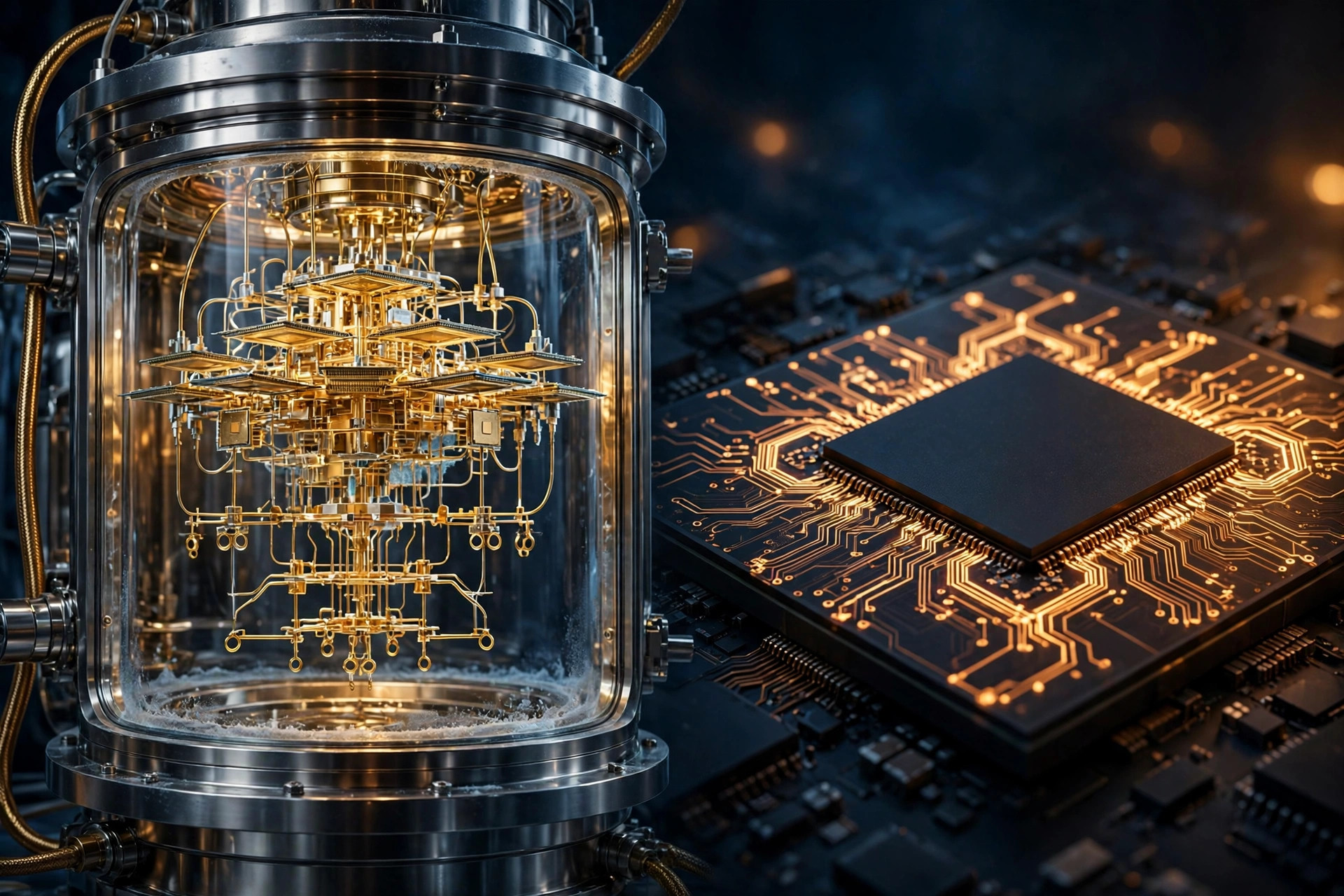
The golden chandelier in photographs of superconducting quantum computers is the most misidentified part of the machine. It is not the computer — it is a refrigerator, a dilution refrigerator. The quantum chip occupies a small plate at the very bottom; almost everything else exists to hold that chip at 10–15 mK, hundreds of times colder than interstellar space at 2.7 K. This article explains why it has to be that cold and how dilution refrigeration gets there.
Why 10–15 mK?
A superconducting qubit such as a transmon has a transition frequency of roughly 4–6 GHz, corresponding to an energy hf equivalent to about 0.2–0.3 K of thermal energy. The criterion for “cold enough” is simple: thermal energy kT must be far below that transition energy, or thermal fluctuations will spontaneously excite the qubit from its ground state and the prepared initial state is wrong before the computation starts. Thermal occupation falls as exp(−hf/kT); only when the temperature drops to roughly a twentieth of the transition energy — 10–15 mK for a 5 GHz qubit — does the thermal population become negligible.
Low temperature also suppresses two other enemies. The first is quasiparticles: thermal energy or stray radiation breaks Cooper pairs, and the resulting quasiparticles tunnel across Josephson junctions, draining the qubit’s energy and phase information; the colder the device, the lower the equilibrium quasiparticle density. The second is thermal noise: Johnson noise arriving down control lines from room-temperature electronics would heat the qubit directly if the lines were not attenuated and filtered at successive cold stages. Millikelvin operation is not showmanship — it is a precondition for this hardware route to work at all.
Dilution Refrigeration: Cooling by Phase Separation
The heart of the machine is a phenomenon unique to mixtures of helium-3 and helium-4. Below about 0.87 K, the mixture spontaneously separates into two phases: a concentrated phase of nearly pure ³He floating on top, and a dilute phase of ³He dissolved in superfluid ⁴He below, with a sharp phase boundary between them. Crucially, even as temperature approaches absolute zero, the solubility of ³He in the dilute phase stays finite at about 6.6% — it never drops to zero.
That fact makes a continuous cooling cycle possible. In the mixing chamber, ³He atoms cross the phase boundary from the concentrated phase into the dilute phase. The process is exactly analogous to evaporation — molecules escaping a liquid — and like evaporation it absorbs heat, cooling the mixing chamber. The outgoing dilute stream is pumped away; in the still, held at about 0.8 K, the ³He is preferentially evaporated out (⁴He has a far lower vapor pressure and mostly stays behind), then compressed, purified, re-condensed and returned to the mixing chamber. As long as the circulation runs, ³He keeps “evaporating” across the boundary and the mixing chamber stays at the 10 mK scale continuously. That is dilution refrigeration’s decisive advantage over techniques such as adiabatic demagnetization, which typically cool in single shots: quantum computing needs a machine that stays cold for years, not for one experiment.
The Cold Plates: Five Stages, Five Jobs
Inside a modern dry dilution refrigerator is a stack of metal plates, each colder than the one above, each acting as a line of defense:
| Stage | Typical temperature | Role |
|---|---|---|
| 50K plate | ~40–50 K | First pulse-tube stage; intercepts most radiative and conducted heat from room temperature |
| 4K plate | ~3–4 K | Second pulse-tube stage; condenses the ³He/⁴He mixture; many cryogenic amplifiers and cables anchor here |
| Still | ~0.8 K | Evaporates ³He out of the returning stream; provides a sub-kelvin thermal anchor for wiring |
| CPX (cold plate) | ~100 mK | Further thermal anchoring of lines and filters; blocks heat leaking toward the bottom |
| MXC (mixing chamber) | ~10 mK | The dilution unit itself; the quantum chip mounts here; cooling power is only a few hundred microwatts |
Every cable entering the refrigerator must be thermally anchored at each stage — wrapped and clamped to the plate so it reaches that stage’s temperature instead of conducting heat down its metal core to the chip. Radiation shields wrap each stage, cutting radiative load step by step.
Heat Load and Wiring: The Real Bottleneck
Cooling power collapses with temperature: watts are available at 4 K, but at the mixing chamber only a few hundred microwatts (typically a few hundred µW at 100 mK, and less at lower temperatures). Meanwhile each superconducting qubit needs several coaxial lines — microwave drive, flux bias, and readout lines with distinct jobs. Every line is a heat leak running from room temperature to 10 mK: conduction down the metal, plus the attenuators installed at each stage to suppress thermal noise, which convert signal energy into heat that must be dumped at that stage.
Scaling therefore becomes strict thermal accounting. Double the qubits and the cables and attenuators roughly double, while MXC cooling power stays fixed. Cryogenic multiplexed readout, cryo-CMOS control electronics and optical interconnects are all being explored, but none has fully dissolved the constraint. This is why experts ask about a machine’s wiring architecture and cold-plate heat budget, not just its qubit count: the refrigerator quietly sets the ceiling on scale.
The Pulse Tube: Pre-Cooling Without Liquid Helium
Early dilution refrigerators were “wet”: the whole insert sat in a liquid-helium bath for pre-cooling, requiring regular refills of expensive, supply-constrained helium. Modern systems are “dry”: a pulse tube cryocooler provides the 50 K and 4 K stages, the mixture condenses at the 4 K plate, and no liquid helium is ever needed.
The pulse tube’s key virtue is that it has no moving parts at the cold end. It transports heat through the periodic compression and expansion of high-pressure helium gas (acoustic power); the only machinery sits in the room-temperature compressor. That yields long life, low maintenance and low vibration — and vibration is itself a noise source for qubits, so quiet is performance. The trade-off is reach: a pulse tube stops around 4 K, and the dilution unit takes over below that. But it is the pulse tube that turned the dilution refrigerator from a laboratory craft object into equipment that runs unattended for years.
References
- Bluefors, How Does a Dilution Refrigerator Work?: https://bluefors.com/blog/how-does-a-dilution-refrigerator-work/
- Oxford Instruments, Dilution Refrigerators product and principles pages: https://www.oxford-instruments.com/products/nanoscience/quantum/dilution-refrigerators
- Krinner et al., Engineering cryogenic setups for 100-qubit scale superconducting circuit systems, EPJ Quantum Technology 6 (2019): https://epjquantumtechnology.springeropen.com/articles/10.1140/epjqt/s40507-019-0072-0
Tags: Dilution RefrigerationSuperconducting QubitsCryogenics