
Post-Quantum Frontier · HARDWARE
Hardware & Chips
Quantum processors, secure chips and hardware security technology.
80 articles 10 subcategories Updated 2026.11.22
What this section is about
Security ultimately lands in silicon and cryogenics.
- The hardware reality of each quantum processor route
- PQC support progress in HSMs and secure chips
- Side channels: attack and defence at the hardware layer
Subcategories
Articles in this section
Anatomy of a Quantum Processor: The Chip Is Only the Tip of the Machine
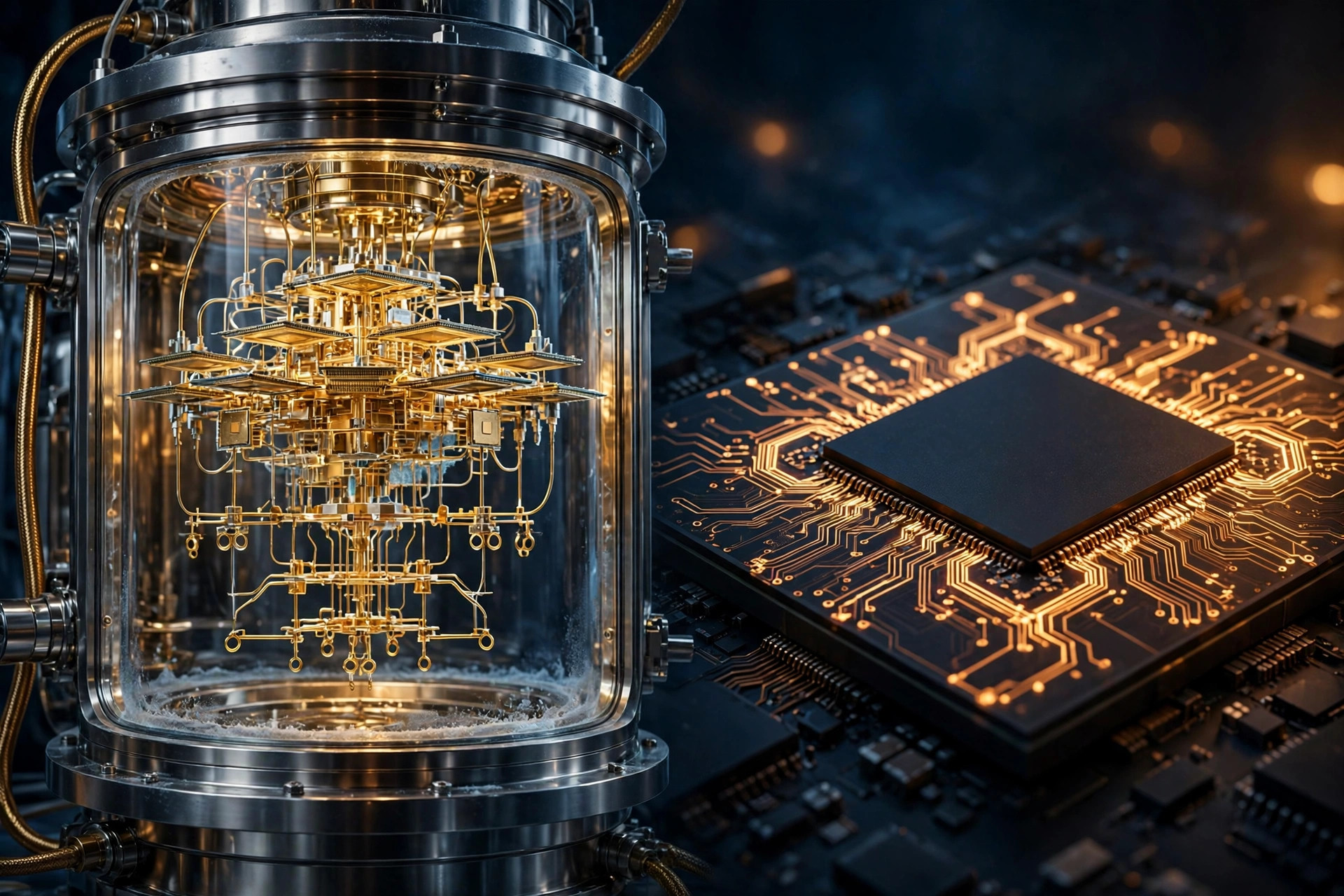
The golden chandelier and the fingernail-sized chip in press photos are only the innermost layer of a quantum processor. This article dissects a complete quantum computer from the whole-machine perspective: the quantum chip, cryogenic and vacuum systems, control and readout electronics, wiring and interconnects, classical compute and the software stack — and the cost and engineering weight of each.
Quantum ProcessorsSystems EngineeringCryogenicsControl Electronics
Arbitrary Waveform Generators and Pulse Shaping: Writing the Rotation Angle into the Waveform
A quantum gate is not a switching action but a precisely sculpted stretch of waveform. The AWG draws the waveform point by point, while pulse shaping decides the gate's speed, leakage and error. This article explains how sampling rate, quantisation and bandwidth limit waveform fidelity, and what Gaussian envelopes and DRAG corrections each fix.
Arbitrary Waveform GeneratorPulse ShapingQuantum Gate Control
Calibration and Drift Management: Living Long-Term with a Machine That Never Stops Changing
A quantum processor's parameters never sit still: qubit frequencies wander, gains drift, and a gate calibrated yesterday quietly worsens today. Calibration and drift management are the engineering system for living with this change — what to calibrate, how often, and how to budget between calibration overhead and data quality decide the machine's usable output.
CalibrationDrift ManagementQuantum Processor Operations
Chip-Level Key Storage and Tamper Resistance: Opening the Chip Should Not Yield the Keys
Where keys live inside a chip and in what form they exist determines the difficulty of physical attack; active shield meshes, environmental sensors and triggered zeroisation make the act of opening a chip itself costly.
Key StorageTamper ResistancePhysical SecurityAnti-Tampering
Cleanliness and Defect Control: Quantum Chips Fear Dirt More Than Transistors Do
One dust particle can kill a transistor, but it takes only a few atomic-scale defects to kill a qubit. This article explains how the logic of semiconductor cleanliness control extends to quantum devices: the damage mechanisms and control methods for particles, metal contamination, organic residues and interface states.
cleanliness controldefect engineeringyield
Cloud HSM Forms and Trade-offs: Before You Put Root Keys in the Cloud
Cloud HSM turns the hardware security module into an on-demand service, but its forms differ enormously: dedicated devices, cluster partitions and software equivalents carry completely different trust models. Choose the wrong form and the operations you saved come back as risk.
Cloud HSMHSMTrust Model
Before Comparing Quantum Chips, Get the Dimensions Right: Quality, Count, Connectivity, Speed
The most common mistake in cross-platform quantum chip comparison is crushing one number with another. This article lays out a four-dimensional framework — qubit quality, qubit count, connectivity, and operating speed — explaining what each dimension measures, how the dimensions constrain one another, and why 'which route is strongest' has no answer outside an application context.
chip comparisonquantum processorsperformance dimensions
Compound Semiconductors and Photonic Devices: The Fabrication Base of Quantum Light Sources
The photonic quantum route does not run on silicon but on compound semiconductors such as gallium arsenide and indium phosphide. This article explains why compound semiconductors are irreplaceable for emission and photoconversion, the fabrication essentials of quantum-dot single-photon sources and on-chip waveguides, and how they differ from the silicon photonics platform.
compound semiconductorsphotonic devicessingle-photon sources
Layers of the Control Software Stack: Five Translations Between a Quantum Circuit and Waveform Samples
A line of quantum circuit code submitted by a user must pass through five layers of translation — compilation, pulse scheduling, waveform synthesis, hardware abstraction and firmware execution — before it becomes an actual waveform at a qubit port. This article maps each layer's responsibilities and interfaces, the portability benefits of layering, and where errors most easily leak between layers.
Control Software StackQuantum CompilationPulse Scheduling
The Cryocooler Family Tree: Where GM, Pulse Tube and Dilution Each Belong
No single machine covers the road from room temperature to 10 mK: GM and pulse-tube coolers provide the 4 K platform, JT and sorption stages fill the middle, and the dilution unit runs only the final leg.
CryocoolersPulse TubeGM Cooler
Cryogenic Amplifiers: The Noise Relay of HEMTs and Parametric Amplifiers
The first amplifier in a quantum readout chain sets the noise floor for everything after it. This article explains where a HEMT's low cryogenic noise comes from, how a parametric amplifier approaches the quantum limit, and the engineering ledger of the two-stage relay.
Cryogenic ElectronicsParametric AmplifierHEMT
The Energy Ledger: Classical Hardware Power in the PQC and Quantum Era
Will an algorithm changeover send electricity bills soaring? Where does a quantum computer's power actually go? Split the ledger into computation, data movement and cooling, and the energy picture of classical hardware becomes clearer than expected.
Energy efficiencyPower consumptionData centers
Clock Distribution and Multi-Channel Synchronisation: Keeping a Hundred Pulses on the Same Beat
Multi-qubit quantum control requires the waveforms of dozens to hundreds of channels to align at the picosecond level. The clock starts from a single reference and reaches each channel through distribution, multiplication and phase locking, accumulating jitter and skew along the way. This article maps the error sources, the structure of the clock tree, and why phase coherence is a more insidious source of gate error than amplitude precision.
Clock DistributionChannel SynchronisationJitter and Phase Noise
Cryogenic CMOS Control Chips: Moving the Controller into the Fridge
Qubits live in a millikelvin fridge while their controllers sit at room temperature, joined by thousands of cables. Cryogenic CMOS moves control circuitry to 4 K or below; this article explains the motivation, the thermal-budget ledger, and how transistors change their temperament at low temperature.
cryogenic CMOScontrol electronicsthermal budget
Cryogenic Electronics: Why the Control Circuits Are Moving into the Fridge
Moving control electronics from room temperature down to 4 K — or colder stages — is one of the most closely watched routes to scaling quantum computing. The motivation is wiring and latency; the constraints are the refrigerator's cooling power and how chips behave at low temperature. This article tallies the ledger of the move down: what each temperature stage can host, and what it cannot.
Cryogenic ElectronicsCryo-CMOSCooling Power
Life at Ten Millikelvin: Dilution Refrigeration for Superconducting Qubits
Superconducting qubits operate hundreds of times colder than deep space. How a dilution refrigerator reaches 10 mK with ³He/⁴He phase separation — and why wiring, not cooling, is the real bottleneck.
Dilution RefrigerationSuperconducting QubitsCryogenics
Anatomy of a Cryostat: The Temperature Layers from Vacuum Vessel to Mixing Chamber
Take a dilution refrigerator apart layer by layer: vacuum vessel, radiation shields, the 50 K and 4 K plates, the Still, the cold plate and the mixing chamber — every layer has a defined temperature, job and mounting rule.
CryostatDilution RefrigerationTemperature Stages
Heat-Load Budgeting: Keeping the Thermal Books of a Cryogenic System
Every cold plate has a cooling-power ceiling; a heat-load budget lists radiation, conduction, cabling and dissipation line by line against that ceiling — the stage that is overspent is the reason the system never reaches its target temperature.
Heat LoadCryogenic EngineeringThermal Design
Digitizers and High-Speed Acquisition: The Hop That Turns Microwave Waveforms into Data
High-speed analog-to-digital conversion is the gateway where quantum control crosses from the analog world into the digital. This article explains how sampling rate, effective number of bits and trigger synchronization jointly decide acquisition quality, and why real-time processing in an FPGA is irreplaceable.
High-Speed AcquisitionAnalog-to-Digital ConversionFPGA
Operating a Dry System: 'Cryogen-Free' Does Not Mean Maintenance-Free
Dry (cryogen-free) dilution systems abolish the liquid-helium dewar and its transfer losses, but shift the maintenance onto compressors, pumping groups and cold heads — here is the real operations bill and the common failure modes.
Cryogen-FreeDry DilutionOperations
Environmental Sensing: Magnetic Fields and Temperature, the Invisible Gatekeepers of Quantum Hardware
Quantum devices are far more sensitive to magnetic-field drift and temperature fluctuation than classical electronics. This article explains how laboratories monitor these two environmental quantities, and how the sensing data feeds back into device stability.
Environmental MonitoringMagnetic ShieldingCryogenic Thermometry
Fabrication Consistency and Yield: Why Frequency Spread Is the Quantum Chip's Number-One Enemy
Quantum chip yield is not simply the fraction of working chips: every qubit's frequency, coherence time, and coupling strength must land inside its window. This article dissects the sources of frequency spread, the frequency-collision problem, post-fabrication trimming such as laser annealing, and how yield statistics feed back into process improvement.
yieldfrequency spreadprocess consistencylaser annealing
Reading FIPS 140-3 Certification Levels: The Numbers and Boundaries on the Certificate
'FIPS 140-3 Level 3 certified' carries far more information than it appears to: each level is the outcome of eleven separately rated areas, and a certificate covers an exact module boundary and version range. Learn to read the certificate and marketing language loses its power to mislead.
FIPS 140-3CertificationCompliance
Accelerating Cryptography with FPGAs and GPUs: A Ledger of Trade-offs
GPUs excel at batches of identical work; FPGAs excel at custom pipelines—but accelerating cryptography is never just a matter of plugging in hardware. Latency, batch shape, flexibility and engineering cost all belong in the same ledger.
FPGAGPUHardware acceleration
FPGA Real-Time Feedback and Fast Reset: Deciding Before the Coherence Runs Out
The feedback loop of quantum error correction is a race against coherence time: readout, discrimination, decision and execution must close the loop within microseconds. General-purpose processors are too slow; the job falls to FPGAs. This article tallies the loop's latency budget, the implementation routes for fast reset, and why deterministic latency matters more than average speed.
FPGAReal-Time FeedbackFast Reset
Helium-3: Where the Lifeblood Gas of Dilution Refrigeration Comes From, and How It Is Recovered
Helium-3 is not mined; it is the decay product of tritium. Its scarcity, cost and strategic status are why every laboratory treats recovery and leak prevention as first-order business.
Helium-3Dilution RefrigerationGas Recovery
HSM Clusters, Backup and Disaster Recovery: Keys Must Neither Be Lost Nor Multiplied
Losing the keys inside an HSM is a disaster; so is having too many copies of them. Cluster synchronization provides availability, while cloning domains and sealed backups provide recoverability — both resting on one premise: copying may only happen between controlled boundaries.
HSMClustersDisaster Recovery
HSM Architecture and the Trust Boundary: Inside and Outside the Cryptographic Boundary
An HSM's security does not come from a chip alone: the cryptographic boundary, tamper-resistant enclosure, firmware, interfaces and management channels together shape what is trusted. Understanding the architecture is the only way to know what it does — and does not — guarantee.
HSMTrust BoundaryTamper Resistance
The Operational Reality of HSMs in Migration Projects: Firmware, Windows and Rollback
Writing an HSM into a migration plan is easy; execution is where the truth appears: firmware upgrades need windows, old devices may never support new algorithms, and rollback is not rewind. This article lays out the real friction points of HSM operations in a post-quantum migration.
HSMOperationsPost-Quantum Migration
PQC Support in HSMs: Keys Never Leave the Box — but the Algorithms Must Change
Hardware security modules guard an organization's most critical keys. Moving them to ML-KEM, ML-DSA and SLH-DSA stresses interfaces, firmware and procurement alike.
HSMPKCS#11Post-Quantum Cryptography
HSM Selection: An Evaluation Framework You Can Score Item by Item
The most common mistake in choosing an HSM is comparing only price and throughput. For a device that will serve ten years or more, evaluation should cover algorithms and interfaces, certification, performance, the operations ecosystem and vendor sustainability — here is a workable checking framework.
HSMSelectionProcurement Evaluation
Route Convergence: As Hybrid Systems Become the Consensus, Pure-Route Labels Are Expiring
The competitive narrative of quantum hardware likes to divide camps by physical carrier, but engineering practice is converging: superconducting chips with optical interconnects, shuttled atom arrays, processors deeply coupled to classical control. This article traces the levels at which convergence is happening and why future system comparisons will be contests of architecture, not of carrier.
hybrid systemsquantum interconnectssystem architecture
Calibration Chains and Traceability: Why the Numbers in a Quantum Lab Can Be Trusted
The credibility of a measurement comes from an unbroken calibration chain: from national metrology standards to the laboratory power meter to the loss of every segment of a link. This article explains the logic of traceability and the special in-situ calibrations of quantum control.
Metrology and CalibrationTraceabilityMeasurement Uncertainty
Integrated Control Systems and Modular Instruments: The Evolving Form of Quantum Control
From racks of general-purpose instruments to dedicated quantum control systems, and on to modular card-based platforms — this article traces the logic of quantum control instrumentation's evolution, and the costs and gains integration brings to scaling.
Control SystemsModular InstrumentsQuantum Control
Fabricating Josephson Junctions: How One Layer of Aluminum Oxide Sets a Qubit's Frequency
The heart of a superconducting qubit is a nanoscale aluminum/aluminum-oxide/aluminum sandwich. This article takes apart shadow evaporation and double-angle deposition, oxide formation and aging, resistance-based screening, and why junction-area spread is the first gate of chip yield.
Josephson junctionshadow evaporationsuperconducting qubitsfabrication
The Acceleration Secret of Lattice Arithmetic: Vectorization and SIMD
The core of lattice cryptography is batch after batch of modular multiplications and number-theoretic transforms—exactly what SIMD instruction sets were built for. How AVX2, AVX-512 and NEON speed up ML-KEM and ML-DSA, and what it costs.
Lattice cryptographySIMDNTT
Key Ceremonies and Dual Control: The Day a Root Key Is Born
Generating a root key is the origin of an entire PKI chain of trust. A key ceremony uses process, witnesses and dual control to turn 'no single person can copy the root key alone' from a slogan into an auditable fact.
Key CeremonyDual ControlRoot CA
The Microwave Control Chain: A Signal Highway for a Quantum Computer
From room-temperature waveform synthesis to a qubit port at millikelvin temperatures, a microwave control chain must pass through mixing, amplification, attenuation and filtering. This article dissects the chain, the trade-offs at each stage, and why it is one of the first walls hit when scaling quantum computers.
Microwave ControlControl ChainSuperconducting Qubits
Multi-Chip Modules and Flip-Chip Bonding: Assembling Quantum Processors from Pieces
When one die can no longer hold all the qubits and routing, architectures move to multi-chip modules: compute chips, routing chips, and carriers joined by indium-bump flip-chip interconnect. This article covers the cryogenic process essentials of flip-chip bonding, the signal-integrity challenges of multi-chip modules, and what modularity means for quantum error-correction architectures.
multi-chip modulesflip-chipindium bumpsmodularity
The Compute Reality of Routers and Gateways: Networking Gear's PQC Bill
A network device's control-plane CPU is often surprisingly weak, and its data plane is locked into dedicated silicon—when PQC lands on routers, firewalls and VPN gateways, it collides with the shape of the devices themselves.
Network devicesVPN gatewaysTLS
The Neutral-Atom Processor as a Whole Machine: Cold Atoms Marshalled in a Tweezer Array
A neutral-atom processor marshals hundreds or thousands of atoms into reconfigurable geometries with optical tweezer arrays. This article surveys its composition from the whole-machine perspective: the vacuum system, laser cooling and tweezer arrays, the Rydberg excitation optics and fluorescence-imaging readout, and how dual analog and digital modes shape the machine's design.
Neutral AtomsQuantum ProcessorsOptical Tweezer ArraysRydberg Atoms
On-Chip Wiring and Crosstalk: Every Line Is a Potential Noise Channel
On a quantum chip, drive lines, flux lines, readout lines, and qubits share one surface. This article dissects the topological dilemma of on-chip wiring: the physical sources of crosstalk and calibration matrices, air bridges and ground-plane engineering, line filtering and isolation, and how wiring density becomes a hidden ceiling on qubit count.
on-chip wiringcrosstalkair bridgessignal integrity
Photonics vs. Neutral Atoms: The Hands of Two Routes with Unconventional Origins
Photonic and neutral-atom quantum computing are the two routes whose profile has risen fastest in recent years: one computes with flying photons, the other with cold atoms in optical-tweezer arrays. This article compares their qubit carriers, interaction mechanisms, scaling logic, and weaknesses, showing which future each route is betting on.
photonic quantum computingneutral atomsroute comparison
The Photonic Quantum Processor as a Whole Machine: Light Completing a Computer Inside a Chip
A photonic processor has a form factor all its own: the qubits are photons in flight, and the machine is a chain of single-photon sources, a programmable photonic circuit and single-photon detectors. This article surveys the photonic machine's composition, how measurement-based computing shapes its architecture, and why photon loss is the number-one enemy running through every part of the machine.
Photonic Quantum ComputingQuantum ProcessorsIntegrated PhotonicsSingle-Photon Detection
Embedded Systems and Smart Cards: Where PQC Is Hardest to Fit
Kilobytes of memory, slow CPUs, low-speed interfaces and firmware that never changes for a decade—the resource profile of embedded devices and smart cards is nothing like a server's, and PQC faces a different set of constraints there.
Embedded systemsSmart cardsResource constraints
The Invisible Engine of Quantum Error Correction: Classical Compute Behind Decoding
Every round of fault-tolerant quantum computation emits a batch of syndrome data that must be decoded in real time—the decoder working day and night beside the qubits is the tightest classical-compute demand in the whole system.
Quantum error correctionSurface codeReal-time decoding
PUFs: Turning Manufacturing Variation into a Chip's Fingerprint and Key
Physically unclonable functions turn each chip's unique process variation into responses and keys: nothing stored and hard to copy is the appeal; noise, modelling attacks and reliability are the costs that must be faced head-on.
PUFPhysically Unclonable FunctionsChip FingerprintKey Generation
Quantum Chip Packaging and High-Density Interconnect: From Wire Bonds to Through-Silicon Vias
A quantum chip must ultimately sit in a package that works at millikelvin temperatures and connect to hundreds or thousands of microwave lines. This article covers package materials and mode suppression, wire-bond and flip-chip interconnect, carriers and interposers, through-silicon vias, and how packaging turns from a logistics problem into an architecture problem.
chip packaginginterconnectflip-chipTSV
Quantum Chip Testing and Screening: From Room-Temperature Probe Stations to Full Cryogenic Inspection
Quantum chip testing is a multi-stage pipeline: room-temperature measurements of junction resistance and line continuity, cryogenic per-qubit measurement of frequency, coherence times, and gate fidelities. This article covers what each test level measures, why cryogenic testing is so expensive, and how automated calibration and test throughput become hidden bottlenecks of scaling.
chip testingscreeningcryogenic testingautomated calibration
The Compute Bill for PQC: How Much More Do Classical CPUs Really Pay?
Post-quantum algorithms are often imagined as a crushing computational burden, but public benchmarks paint a subtler picture—the real cost is usually not CPU cycles, but data size and protocol assumptions.
PQC performanceCPUML-KEM
Quantum Processor Benchmarks: How to Read Vendor Numbers — Quantum Volume, CLOPS and Error Rates
Quantum volume, CLOPS, gate error rates, logical error rates — every number in a vendor announcement carries its own definition. This article unpacks the mainstream benchmarks, their scope and common misreadings, and gives an order and checklist for reading vendor claims in the error-correction era.
Quantum VolumeBenchmarkingCLOPSFault-Tolerant Quantum Computing
The Classical Machine Room Behind a Quantum Computer
The chandelier-like cryostat is only the tip of the iceberg—control electronics, calibration pipelines, scheduling systems and power and cooling: most of a quantum facility's hardware, and most of its power draw, are classical.
Quantum computingData centersInfrastructure
How to Read a Quantum Processor Spec Sheet: A Pitfall Guide from Qubit Counts to Logical Performance
Quantum processor marketing is crowded with metrics: qubit counts, fidelities, coherence times, quantum volume, logical error rates. Every metric has its own measurement convention and scope, and mixing them leads to wrong conclusions. This article takes the mainstream metrics apart one by one — their meanings and their traps — and teaches readers to judge a processor's real quality.
Quantum ProcessorsPerformance MetricsQuantum VolumeBenchmarking
How to Read a Chip Comparison Table: Ten Traps in Promotional Numbers
In vendor and media chip-comparison tables the numbers are mostly real, and the misleading part mostly hides in the measurement conditions. This article lists the ten most common traps when reading such tables — best-case values posing as typical ones, mixed generations, missing units and conditions — and gives an item-by-item checklist that returns the comparison table to its proper role: a tool for raising questions, not for declaring winners.
comparison methodsvendor claimscritical reading
Anatomy of a Readout Chain: A Signal's Long March from Millikelvin to Room Temperature
A qubit's readout signal passes through a four-leg relay — cryogenic amplification, room-temperature down-conversion, analog-to-digital conversion and real-time processing. This article unpacks what each instrument in the chain does and how its noise budget is kept.
Quantum ControlReadout ChainMicrowave Instruments
The Readout Chain and Parametric Amplification: Fishing a Single-Photon Signal out of a Sea of Noise
Quantum readout must amplify the feeble microwave signal carrying the qubit state to a level room-temperature electronics can resolve, without destroying the qubit. Every amplifier stage races against noise, and the first-stage parametric amplifier sets the noise floor of the whole chain. This article qualitatively walks through dispersive readout, quantum-limited amplification and the chain's noise budget.
Quantum ReadoutParametric AmplifierNoise Budget
Secure-Chip Certification: What a Certificate Actually Proves
Common Criteria, FIPS 140-3 and industry schemes form the evaluation landscape for secure chips: they prove how rigorously given claims were examined under stated assumptions and configurations — not unconditional, absolute security. Reading certificates well is what makes chip selection work.
Security CertificationCommon CriteriaFIPS 140-3Compliance
Generations of Classical Secure Chips: From Smart Cards to TPM 2.0 and Secure Enclaves
Beyond quantum chips, classical secure chips keep evolving: smart-card secure elements, TPMs, trusted execution environments, and secure enclaves inside modern SoCs. This article traces, generation by generation, how this product line's capability boundary expanded, how its protection philosophy changed, and what different homework the post-quantum migration leaves for each generation.
secure chipsTPMtrusted execution environments
Secure Chips and Side Channels: The Attack Surface Beyond the Algorithm
How secure elements and TPMs guard keys, how power, electromagnetic, and timing side channels bypass mathematical strength, and what PQC implementation research and certification actually tell us.
secure chipsside channelsTPMPQC implementation security
The Secure Boot Chain: Every Stage Verifies the Next Before Handing Over
Secure boot starts from a small immutable ROM and verifies signatures stage by stage, so the trust of the whole software stack traces back to one hash in the fuses. The chain's strength depends on its weakest stage — and on revocation and anti-rollback keeping up.
Secure BootChain of TrustFirmware VerificationAnti-Rollback
Inside a Secure Element: A Tiny Fortress on a Chip
A secure element is not a simple storage chip but a complete miniature computer trimmed for resisting physical attack: compute core, partitioned memory, crypto coprocessors, a true random source and sensors, each with its own job.
Secure ElementChip ArchitectureSmart CardsHardware Security
The Semiconductor Spin Processor as a Whole Machine: A Quantum Computer out of the Fab
The whole-machine story of the semiconductor spin route is unlike any other: its core selling point is not any single machine's performance but the entire manufacturing chain. This article surveys the spin processor's composition from the whole-machine perspective: quantum-dot chips, the cryogenic operating environment, the trend toward integrating on-chip control electronics, and how wafer-scale fabrication changes the machine's cost and consistency.
Semiconductor SpinsQuantum ProcessorsQuantum DotsCMOS Processes
The Semiconductor Supply Chain and Quantum Hardware: On Whose Shoulders Does a Quantum Computer Stand?
However frontier a quantum chip is, it cannot escape wafers, specialty gases, isotope materials and refrigerators. This article maps quantum hardware's dependence on the semiconductor supply chain: which links share mainstream capacity, and which are stuck on niche, fragile supplies.
supply chainsemiconductor industryquantum hardware
SiGe Heterostructures and Isotopically Purified Silicon: A Quiet Home for Electron Spins
Half of a silicon spin qubit's performance is written in its materials. This article explains how Si/SiGe heterostructures use band engineering to confine electrons, why isotopic purification suppresses magnetic noise, and where valley splitting — silicon's peculiar headache — comes from.
SiGe heterostructuresisotopic purificationmaterials engineering
Fabricating Silicon Quantum Dots: From Heterostructure Epitaxy to Multilayer Gates
Silicon quantum dots are not drawn; they are grown, etched and stacked. This article walks through the two mainstream material routes for silicon quantum-dot devices, the gate processes that electrostatically define the dots, and the steps that really limit yield when moving from single devices to arrays.
quantum dotssemiconductor processingsilicon quantum devices
The Positioning of Silicon Spin Qubits: A Slow, Deliberate CMOS Wager
Among quantum computing routes, semiconductor spin qubits rarely headline on per-step metrics, yet they hold a card no one else has: compatibility with CMOS fabrication. This article examines the spin qubit's physical basis, its current metric standing, what the manufacturing alliance really means, and its awkward yet irreplaceable place in the route landscape.
semiconductor spin qubitsCMOSroute positioning
Silicon Spin Qubits: The Route That Builds Quantum Chips on a Semiconductor Production Line
Silicon spin qubits trap the spin of a single electron in a semiconductor quantum dot — the only quantum computing route that can directly borrow CMOS manufacturing. This article explains how they work, the post-2022 milestones that pushed fidelities past 99%, and the manufacturing challenges of uniformity, wiring and temperature.
Silicon Spin QubitsQuantum DotsSemiconductor Fabrication
Spectrum Analysis and Noise Measurement: The Stethoscope of the Quantum Lab
Spectrum analyzers, noise figure and phase-noise measurement are the basic skills of quantum hardware debugging. This article explains what each of these instruments is listening to, and why measuring noise in a cryogenic chain is especially tricky.
Spectrum AnalysisNoise MeasurementMicrowave Instruments
Superconducting Chip Layout and Coupling Structures: How Qubits Are Arranged and Connected
From a single transmon's interdigitated capacitor to the coupler arrays of a two-dimensional grid, this article lays out the design logic of superconducting chip layouts: qubit placement topologies, fixed versus tunable coupling, the role of coplanar waveguide resonators, and how layout-level parasitics constrain the architecture in return.
superconducting chipslayout designcouplerstransmon
Single-Photon Detectors: The Two Roads of SNSPD and APD
The eyes of photonic quantum computing and quantum communication come in two mainstream kinds: superconducting nanowire detectors that trip on a photon's heat, and avalanche photodiodes that multiply a single carrier. This article compares their efficiency, dark counts and operating conditions.
Single-Photon DetectionSNSPDAvalanche Photodiode
The Superconducting Quantum Processor as a Whole Machine: Inside and Beyond the Chandelier
The superconducting route attracts the largest share of industry investment in quantum computing. This article surveys the complete form of a superconducting processor from the whole-machine perspective: the layered structure inside the dilution refrigerator, the microwave control chain, how packaging and wiring swell with qubit count, and the practical constraints — calibration, crosstalk and yield — that decide whether a machine is usable.
Superconducting Quantum ComputingQuantum ProcessorsDilution RefrigerationMicrowave Control
Superconducting Thin-Film Materials: Aluminium, Niobium and Titanium Nitride Each Have Their Own Job
The performance of a superconducting quantum chip hides in its films: aluminium owns the Josephson junction, niobium carries the high-frequency interconnect, and titanium nitride opens another road with high kinetic inductance. This article compares the process personalities and loss sources of the three workhorse superconducting films, and shows how material choice writes itself into qubit coherence.
superconducting thin filmsJosephson junctionsmaterials loss
Superconducting vs. Trapped Ion: Where the Two Mature Routes Place Their Bets
Superconducting circuits and trapped ions are the two most mature routes to quantum computing. This article compares them item by item — physical carrier, gate speed and fidelity, connectivity, scaling path, and engineering ecosystem — showing where each side's strengths come from, where the costs are paid, and why this comparison has no overall champion, only fitting use cases.
superconducting quantum computingtrapped ionsroute comparison
TEE Isolation Models: Two Worlds on One Processor
A TEE adds no separate chip; it carves an isolated region inside the main processor. Normal world versus secure world, enclaves, and confidential virtual machines are three different ways of cutting — with different trust boundaries and different costs.
TEETrusted ExecutionTrustZoneConfidential Computing
The State of Topological Quantum Computing: A Beautiful Promise Not Yet Delivered
Topological quantum computing promises to encode quantum information in the global topological properties of Majorana zero modes, naturally resistant to local noise. Yet for over two decades its core physical evidence has remained under dispute. This article neutrally surveys the route's physical conception, its key experimental controversies and its current state: what has been established, and what has not.
Topological Quantum ComputingMajorana Zero ModesQuantum ProcessorsResearch Status
The Role and Limits of the TPM: An Anchor of Trust, Not a Vault
The TPM is a passive root of trust: it measures boot, seals keys and produces attestations — but it does not monitor runtime, does not replace disk encryption, and cannot repair compromised software. Knowing its boundaries is what makes it useful.
TPMTrusted ComputingRemote AttestationMeasured Boot
The Trapped-Ion Quantum Processor as a Whole Machine: Vacuum Chamber, Lasers and a String of Floating Ions
A trapped-ion processor looks nothing like a superconducting machine: there is no bulky refrigerator — the core is an ultra-high-vacuum chamber, a precision laser-optics system and a trap chip. This article surveys the composition of a trapped-ion machine, how the QCCD zoned architecture reshapes its layout, and the system costs behind all-to-all connectivity and high fidelity.
Trapped IonsQuantum ProcessorsVacuum SystemsLaser Control
Vibration, Acoustic Noise and Electromagnetic Shielding: The Invisible Enemies of the Cold Environment
Reaching base temperature is not the same as a qualified environment: compressor vibration, pump acoustics, stray magnetic fields and infrared radiation quietly destroy coherence — vibration control and shielding are the other half of cryogenic engineering.
Vibration IsolationMagnetic ShieldingCryogenic Environment
Why CMOS Compatibility Matters: The Logic of Quantum Chips Borrowing the Semiconductor Industry
「CMOS compatible」 is often used as a slogan for silicon quantum computing, but what exactly is compatible — and what is not — needs spelling out. This article breaks process compatibility into four levels: materials, equipment, design rules and supply chain, and marks where the incompatibilities lie, from cryogenics to quantum-grade cleanliness.
CMOSsemiconductor processingquantum chip fabrication
Wiring and Heat Sinking: Every Cable Is a Two-Way Channel for Heat and Noise
Cables carry control signals into the cold end — and carry heat and room-temperature noise in with them. Heat sinking, attenuation chains and cable-material choices are the art of setting checkpoints along that channel, stage by stage.
WiringHeat SinkingCoaxial Cables