
Specials
Specials
Single articles solve single points; specials connect the points into lines. Eight specials, eight reading modes: read the standards, run a migration, assess the threat, go inside the algorithms, get hands-on in the lab, do the harvest-now arithmetic, follow error correction, and read the global route race.
First the shape of the threat, then the shape of the defence
Electrons in orbit do not pause for us. Every special here starts by stating the problem precisely.
Special 01
The NIST Standards, Explained
In August 2024 NIST handed the world the first finished post-quantum standards: FIPS 203 (ML-KEM), FIPS 204 (ML-DSA) and FIPS 205 (SLH-DSA). This special reads all three together with their backstories — what problem each algorithm solves, how to choose parameters, and what standardization changed along the way. Finish it and you can judge the algorithm choices in any migration plan for yourself.
ML-KEM Explained: Reading NIST's Post-Quantum Key-Encapsulation Standard (FIPS 203)
Starting from why we need key encapsulation at all, a systematic reading of FIPS 203: the Module-LWE foundation, the three parameter sets, the three core algorithms, and how ML-KEM relates to CRYSTALS-Kyber.
ML-KEMFIPS 203NISTKey Encapsulation
ML-DSA Explained: NIST's Post-Quantum Digital Signature Standard (FIPS 204)
From Dilithium to FIPS 204: how ML-DSA's lattice signatures work, the three parameter sets, why the signatures are large, and where the scheme fits in certificates and code signing.
ML-DSAFIPS 204digital signatureslattice cryptography
SLH-DSA: The Conservative, Hash-Only Signature (FIPS 205)
How SPHINCS+ turns hash trees into a stateless signature scheme: twelve parameter sets, signatures of tens of kilobytes, and the use cases it is built for — offline roots and firmware.
SLH-DSAFIPS 205hash-based signaturesSPHINCS+
From Kyber to ML-KEM: What Standardization Actually Changed
ML-KEM is not Kyber renamed: ciphertext-bound key derivation, domain separation and input validation — a point-by-point account of the FIPS 203 differences, and why the two do not interoperate.
KyberML-KEMFIPS 203standardization
Special 02
Migration Field Manual
Standards answer "with what"; this special answers "how". From building a CBOM inventory, to scheduling backwards from the global timelines, to taking PKI — the hardest subsystem — apart on its own: four articles forming one executable chain. Written to be read in order by the engineers and architects who own a migration.
A Five-Step Roadmap for Post-Quantum Migration
Migration is not swapping one algorithm — it is replacing cryptography everywhere an organisation uses it. Inventory, assess, sequence, pilot, switch: each step with a deliverable.
Migration RoadmapCrypto-AgilityCBOMRisk Assessment
Cryptographic Inventory in Practice: Building a CBOM from Zero
Migration starts with knowing what you have, not swapping algorithms: CBOM field design, the five-channel discovery method, tooling choices and a prioritization workflow you can execute.
CBOMinventorycrypto-agilityCycloneDX
Global Migration Timelines Compared: CNSA 2.0, NIST IR 8547, the EU and the UK
The major official timelines on one table: what must be done by 2030, the shared 2035 endpoint, and which line an enterprise should plan against.
CNSA 2.0NIST IR 8547migration timelinescompliance
Migrating PKI and Certificates to Post-Quantum: Size, Chains and Automation
Certificates are among the first systems to hit the post-quantum wall: the size arithmetic of ML-DSA chains, composite versus dual-certificate transition paths, and the CA ecosystem's timeline.
PKIX.509certificatesML-DSA
Special 03
Assessing the Quantum Threat
"When will a quantum computer break RSA" is not a news question; it is an estimation problem. This special decomposes the threat into trackable variables: the resources Shor's algorithm needs, the pace of error correction, where the five hardware routes really stand, and why symmetric cryptography only needs longer keys. After it, you can calibrate your timeline with three numbers instead of headlines.

Shor's Algorithm: How Quantum Computing Threatens RSA and Elliptic-Curve Cryptography
Starting from why factoring and discrete logarithms are hard, an explanation of Shor's core idea, how large a quantum computer breaking RSA-2048 would have to be, and why 'harvest now, decrypt later' makes migration a present-day task.
Shor's AlgorithmRSAQuantum ThreatHarvest Now Decrypt Later
Quantum Error Correction: Surface Codes, Thresholds and Logical Qubits
Why a quantum computer needs thousands of physical qubits to protect one logical qubit — error models, the surface code, the threshold theorem, and Willow's below-threshold demonstration.
quantum error correctionsurface codefault tolerance
The Quantum Hardware Landscape: Superconducting, Trapped-Ion, Neutral-Atom, Photonic and Topological
The five leading hardware routes — their physical carriers, representative players, fidelities and scaling bottlenecks — and the metrics that actually matter when judging any of them.
quantum hardwaresuperconductingtrapped ionneutral atom
Grover's Algorithm and Symmetric Cryptography: Is AES-128 Still Safe?
Quantum search gives only a quadratic speedup: why doubling key length is enough for symmetric ciphers, how to choose hashes, and how NIST's security categories are calibrated.
GroverAESsymmetric cryptographyhashing
Special 04
Inside the Algorithms: Lattices
Why did lattices win? This special goes inside the algorithms: why lattice problems stay hard in hundreds of dimensions, how Falcon samples short signatures from a Gaussian over a lattice, what did and did not change between Kyber and ML-KEM, and how hybrid exchange welds classical and post-quantum into a double lock. For readers who want selection arguments at the level of the mathematics.
Why Lattices Are Hard: From LWE to Module-LWE
One noisy linear equation carries the security of ML-KEM and ML-DSA. Where LWE's hardness comes from, Regev's worst-case reduction, and the structure-for-efficiency trade of Module-LWE.
LWELattice CryptographyModule-LWESecurity Reductions

Falcon and FN-DSA: The Smallest Post-Quantum Signature Is the Hardest to Build
How Gaussian sampling over NTRU lattices squeezes a signature into about 666 bytes — Falcon's design, its floating-point trap, and the road to FIPS 206.
FalconFN-DSAFIPS 206NTRU
From Kyber to ML-KEM: What Standardization Actually Changed
ML-KEM is not Kyber renamed: ciphertext-bound key derivation, domain separation and input validation — a point-by-point account of the FIPS 203 differences, and why the two do not interoperate.
KyberML-KEMFIPS 203standardization
Hybrid Key Exchange: Why Post-Quantum Migration Starts with TLS
Run classic X25519 and ML-KEM-768 side by side and combine the secrets — hybrid key exchange is deployable today, and it is step one of the whole migration.
Hybrid EncryptionTLSML-KEMHarvest Now Decrypt Later
Special 05
The Lab: Run PQC Yourself
Reading ten times beats running once — no, the other way round. This special is all hands-on: generate and verify ML-KEM keys and ML-DSA signatures with liboqs, then bring up a real hybrid TLS connection with OpenSSL. Every article gives full commands and expected output; afterwards, parameter sizes and handshake costs are muscle memory.
Hands-On: Your First ML-KEM Key Encapsulation with liboqs
Use the Open Quantum Safe Python bindings locally to run ML-KEM-768 key generation, encapsulation and decapsulation — and verify that both sides arrive at exactly the same shared secret.
liboqsML-KEMPythonLab
Hands-On: Your First ML-DSA Signature with liboqs
In the liboqs environment from the previous lab, run the full ML-DSA flow: key generation, signing, verification, a tamper test that must fail, and a size comparison across all three parameter sets.
liboqsML-DSAPythonlab
Hands-On: Local TLS with ML-KEM + ML-DSA Using OpenSSL 3.5
No research libraries needed: use the OpenSSL 3.5 shipped by mainstream distributions to issue an ML-DSA certificate, serve local TLS, and verify hybrid key exchange negotiation yourself.
OpenSSLTLSML-KEMML-DSAlab
ML-KEM Explained: Reading NIST's Post-Quantum Key-Encapsulation Standard (FIPS 203)
Starting from why we need key encapsulation at all, a systematic reading of FIPS 203: the Module-LWE foundation, the three parameter sets, the three core algorithms, and how ML-KEM relates to CRYSTALS-Kyber.
ML-KEMFIPS 203NISTKey Encapsulation
Special 06
Harvest Now, Decrypt Later
The quantum computer is not here, but the attack has already started — adversaries are recording your encrypted traffic today. This special takes HNDL apart: the time structure of the threat, why hybrid exchange is the best-value defence available now, how one TLS connection becomes future-proof from today, and how much window the global timelines leave you.
Shor's Algorithm: How Quantum Computing Threatens RSA and Elliptic-Curve Cryptography
Starting from why factoring and discrete logarithms are hard, an explanation of Shor's core idea, how large a quantum computer breaking RSA-2048 would have to be, and why 'harvest now, decrypt later' makes migration a present-day task.
Shor's AlgorithmRSAQuantum ThreatHarvest Now Decrypt Later
Hybrid Key Exchange: Why Post-Quantum Migration Starts with TLS
Run classic X25519 and ML-KEM-768 side by side and combine the secrets — hybrid key exchange is deployable today, and it is step one of the whole migration.
Hybrid EncryptionTLSML-KEMHarvest Now Decrypt Later
Hands-On: Local TLS with ML-KEM + ML-DSA Using OpenSSL 3.5
No research libraries needed: use the OpenSSL 3.5 shipped by mainstream distributions to issue an ML-DSA certificate, serve local TLS, and verify hybrid key exchange negotiation yourself.
OpenSSLTLSML-KEMML-DSAlab
Global Migration Timelines Compared: CNSA 2.0, NIST IR 8547, the EU and the UK
The major official timelines on one table: what must be done by 2030, the shared 2035 endpoint, and which line an enterprise should plan against.
CNSA 2.0NIST IR 8547migration timelinescompliance
Special 07
The Road to Quantum Error Correction
One thing stands between quantum computers and usefulness: getting the errors down. This special starts from the surface-code correction cycle, passes the real progress of the five hardware routes, and returns to threat estimation itself — every step in error correction rewrites RSA’s remaining lifetime. For readers who want the "quantum threat timeline" as numbers, not slogans.
Quantum Error Correction: Surface Codes, Thresholds and Logical Qubits
Why a quantum computer needs thousands of physical qubits to protect one logical qubit — error models, the surface code, the threshold theorem, and Willow's below-threshold demonstration.
quantum error correctionsurface codefault tolerance

Qubits, Gates, and Circuits: The Minimal Language of Quantum Computing
Starting from a single qubit on the Bloch sphere, this article explains the Hadamard, CNOT, and phase gates as unitary matrices, how to read a circuit diagram, and why the set {H, T, CNOT} is universal.
QubitQuantum GatesQuantum CircuitsBloch Sphere
The Quantum Hardware Landscape: Superconducting, Trapped-Ion, Neutral-Atom, Photonic and Topological
The five leading hardware routes — their physical carriers, representative players, fidelities and scaling bottlenecks — and the metrics that actually matter when judging any of them.
quantum hardwaresuperconductingtrapped ionneutral atom
Shor's Algorithm: How Quantum Computing Threatens RSA and Elliptic-Curve Cryptography
Starting from why factoring and discrete logarithms are hard, an explanation of Shor's core idea, how large a quantum computer breaking RSA-2048 would have to be, and why 'harvest now, decrypt later' makes migration a present-day task.
Shor's AlgorithmRSAQuantum ThreatHarvest Now Decrypt Later
Special 08
Global Quantum Computing Technology Routes
Superconducting, ion-trap, photonic, neutral-atom — four mainstream routes, four different physical and engineering bets. This special lays out the contest: where each route’s scaling bottleneck sits, what the world’s major research institutions are backing, and how the outcome will set the urgency of the cryptographic migration.
The Quantum Hardware Landscape: Superconducting, Trapped-Ion, Neutral-Atom, Photonic and Topological
The five leading hardware routes — their physical carriers, representative players, fidelities and scaling bottlenecks — and the metrics that actually matter when judging any of them.
quantum hardwaresuperconductingtrapped ionneutral atom
Neutral Atoms and Photonics: Two Hardware Routes Off the Beaten Path
Optical-tweezer arrays and Rydberg blockade make neutral-atom machines natively reconfigurable, while the measurement-based model gives photonics room-temperature optics and natural networking. This article explains both mechanisms, their scaling bottlenecks, and how they compare with superconducting and trapped-ion platforms.
Neutral AtomsPhotonicsRydberg BlockadeHardware Routes
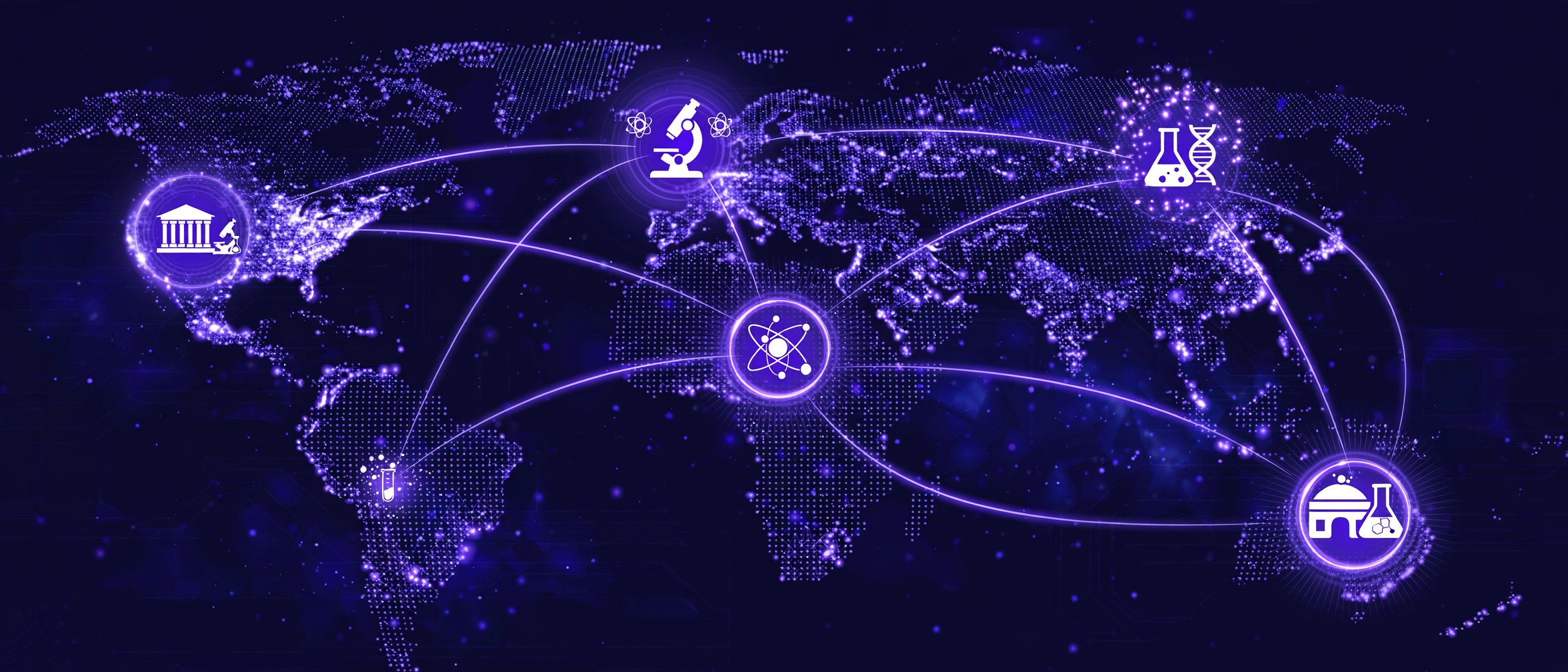
A Map of Global Quantum Research Institutions: Who Does What
A region-by-region map of leading quantum research institutions across North America, Europe and Asia — standards bodies, university institutes and national laboratories — with their types and public research directions.
research institutionsNISTIQCQuTechinstitution map
Quantum Entanglement: From the EPR Debate to an Information Resource
How Bell states, the EPR paradox and Bell inequalities settled the local-hidden-variable debate — and why entanglement cannot signal faster than light, yet powers teleportation and superdense coding.
quantum entanglementBell inequalitiesquantum teleportation
Timeline
The Post-Quantum Standardization Timeline
From a 2016 call for proposals to the 2035 zero line — with the key nodes on one line, the "why now" of migration planning explains itself.
NIST opens the PQC standardization process
In December 2016 NIST issued its call for proposals; the world's cryptographers submitted 82 candidate schemes. Post-quantum migration has had official coordinates ever since.
Round three narrows the field
In July 2020 NIST announced the third round: seven finalists and eight alternates, with Kyber, Dilithium, Falcon and SPHINCS+ in the final — the lattice and hash routes pulling ahead.
First selections announced
In July 2022 NIST selected CRYSTALS-Kyber for key establishment and Dilithium, Falcon and SPHINCS+ for signatures; the NSA published the CNSA 2.0 timeline the same year.
FIPS 203/204/205 published
On 13 August 2024 the three federal standards landed on the same day: ML-KEM, ML-DSA, SLH-DSA. The post-quantum era stopped being future tense.
Willow demonstrates below-threshold correction
In December 2024 Google published surface-code scaling in Nature: distance 3 to 5 to 7, logical error rates falling about 2.14× per step. The threat-side clock is ticking faster than many expected.
HQC selected; global roadmaps align
In March 2025 NIST selected HQC as the backup KEM to ML-KEM; in April the EU published its coordinated roadmap and the UK NCSC its three-phase guidance. The major economies' timelines aligned this year.
FN-DSA (FIPS 206) expected
Falcon's standard, FN-DSA, is expected to complete its publication process around 2026–2027 — the last standards puzzle piece for small signatures.
The shared high-priority deadline
CNSA 2.0, the EU roadmap and NIST IR 8547 converge on 2030: high-risk and high-priority systems migrated, classical public key at ≤112-bit security deprecated.
CNSA 2.0 full-transition target
The NSA set 2033 as the target year for national security systems to complete the transition under CNSA 2.0: software and firmware signing, web and cloud, and traditional networking equipment switch in phases before it.
The zero line for classical public key
NIST IR 8547 disallows quantum-vulnerable algorithms from 2035; the UK and EU full-transition targets are also 2035. Treat it as the default endpoint of long-range planning.