
← Back to section · Quantum-Safe Industry
Quantum-Safe Networks: The Main Road for Backbones, Where MACsec Fits, and the QKD Disagreement
Backbone quantum-safety is mainly a software story — hybrid key exchange in TLS and IPsec. QKD faces genuinely differing positions from national security agencies. This article keeps the routes and the evidence separate.
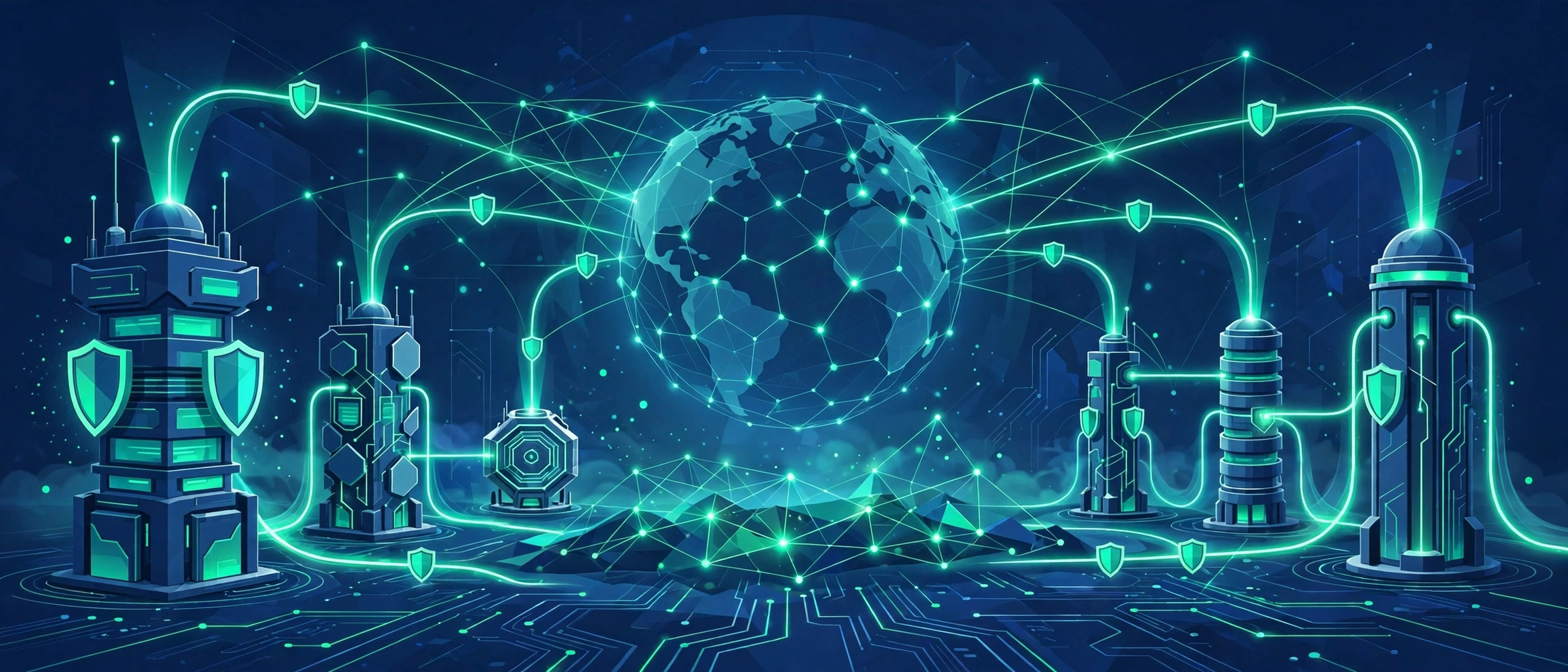
“Quantum-safe network” is used in the market for two entirely different things: upgrading existing network protocols with post-quantum cryptography (PQC), and building dedicated quantum key distribution (QKD) networks. Their cost, maturity and official endorsement differ enormously, and planning must keep them apart.
The main road: upgrading existing protocols with PQC
Traffic protection on backbone and enterprise networks rests mainly on three protocol layers, and each has a defined post-quantum path:
- TLS 1.3: the hybrid group X25519MLKEM768 is deployed in browsers, CDNs and major libraries (see our IETF survey), so application-layer encryption on backbones follows routine software upgrades;
- IPsec: gateway-to-gateway tunnels remain the workhorse of backbone and branch interconnect. RFC 9370 (multiple key exchanges in IKEv2) lets an IKE negotiation stack classical and post-quantum exchanges such as ML-KEM — the standard path for hybrid PQC in VPN gateways. RFC 8784 post-quantum preshared keys (PPKs) are a lighter transitional option;
- MACsec (IEEE 802.1AE): link-layer encryption uses AES-GCM, a symmetric algorithm with no public-key component; quantum impact is limited to Grover’s algorithm halving effective strength, which moving from AES-128 to AES-256 addresses. What actually needs attention is the public-key machinery in its key-distribution path (such as MKA key agreement over EAP-TLS). Listing MACsec as “needs a new cipher” is a common inventory error.
The shared properties of this road: software upgrades, incremental deployment, compatibility with existing operations. It is also the upgrade model that national migration timelines assume by default.
Do not forget the management plane while upgrading the data plane. Administrative SSH access to routers and gateways, and management protocols carried over TLS, traverse the same networks and authenticate the people who control them. OpenSSH’s ML-KEM hybrid default makes much of this an upgrade exercise rather than a project, but unmanaged legacy devices with classical-only key exchange are a common audit finding precisely because nobody listed them as part of “the network”.
QKD: engineering facts and diverging agency positions
QKD negotiates keys by transmitting quantum states, in theory making eavesdropping detectable. The engineering facts are equally clear: QKD covers point-to-point key agreement only, provides no authentication by itself (authentication still needs classical or PQC signatures), is distance-limited, needs trusted relay nodes over long distances, and its rates and costs are in a different world from classical networking.
Published positions of national security agencies genuinely diverge:
- The UK NCSC, in its QKD position paper, does not endorse QKD for practical government or critical-infrastructure security needs and recommends PQC as the migration main line;
- The US NSA publicly advises against QKD for national security systems, citing that it solves only part of the problem and requires specialized equipment and trusted relays;
- France’s ANSSI is comparatively milder but equally clear: QKD can at most be a supplementary defence-in-depth layer, not a substitute for algorithm migration;
- In contrast, programmes such as the EU’s EuroQCI initiative and China’s satellite-and-ground quantum network experiments continue to invest in QKD research and pilots at infrastructure level.
The conclusion is not “QKD is useless” but: in mainstream security-agency frameworks, QKD is not a substitute for PQC. Its defensible place is research reserve and, in rare cases, an additional layer on a small number of high-value point-to-point links. Buying QKD as a way to “complete” post-quantum migration is a budget misallocation.
A concrete scenario: data-centre interconnect (DCI)
The three-layer picture becomes clearest on one concrete case. Metro and inter-city data-centre interconnects typically run MACsec (link encryption) together with IPsec or TLS above it. The quantum-safe upgrade for such links is mostly bookkeeping and software: on the MACsec side, confirm AES-256 and the key-distribution path; on the IPsec/TLS side, enable hybrid key exchange as gateway and software versions allow. No fibre replacement is involved, and there is no need to build QKD for interconnect links. DCI usually carries replication and backup traffic — a prime “harvest now, decrypt later” target — so it belongs in the first batch of any network upgrade plan.
The same layered logic applies to carrier backbones: traffic protection for inter-domain border gateways and label-switched transport networks ultimately comes back to the same two lines, IPsec and MACsec. In engineering terms, a “quantum-safe backbone” is never a new network — it is the existing network with its key exchange replaced segment by segment. Grasping this filters out a large share of market narratives that repackage routine equipment upgrades as dedicated quantum networks.
The hybrid route: how to sequence a real plan
For most organisations, a pragmatic quantum-safe network plan looks like this:
- Inventory first: map TLS, IPsec and MACsec versions and key-exchange methods across backbone and interconnect links (the network part of a CBOM);
- Software first: upgrade gateways and termination devices along vendor roadmaps to versions supporting hybrid key exchange, prioritising links that carry long-shelf-life data;
- Check the symmetric layer: confirm AES-256 and the key-distribution path for MACsec and leased-line encryption instead of redoing the encryption layer;
- Argue QKD separately: if there is a real requirement, scope it as additional defence-in-depth with its own budget, and require the vendor to answer the engineering limitations listed by NCSC, NSA and ANSSI.
The easily missed layer: routing, time and the DNS
Backbone security also rests on three inconspicuous signature and channel systems. Routing security (RPKI) uses certificates and signatures to vouch for IP prefix origin authorisation, and its certificate hierarchy shares the same public-key base as TLS, so its migration pace is bound to the CA ecosystem as a whole. Network time: NTS (RFC 8915) gives NTP a TLS-protected key exchange, and its post-quantum transition follows the TLS 1.3 hybrid groups naturally — but if time itself can be manipulated, certificate validity checks and log forensics both lose their footing, so this channel should not be scheduled last. DNSSEC faces a size problem: DNS messages are small and fragmentation-sensitive, post-quantum signatures such as ML-DSA are significantly larger than incumbent algorithms, and algorithm replacement on the DNS side is still at an early stage of standardisation and experiment. Listing these three items separately in a network migration inventory avoids the mismatch of “the backbone is upgraded while the trust anchors still sit on classical algorithms”.
References
- UK NCSC, Quantum key distribution (position paper). https://www.ncsc.gov.uk/whitepaper/quantum-key-distribution
- NSA, Quantum Key Distribution (QKD) and Quantum Cryptography (QC) (FAQ and position). https://www.nsa.gov/Cybersecurity/Quantum-Key-Distribution-QKD-and-Quantum-Cryptography-QC/
- ANSSI, ANSSI views on the post-quantum cryptography transition (including its QKD position). https://cyber.gouv.fr/en/publications/anssi-views-post-quantum-cryptography-transition
- IETF, RFC 9370: Multiple Key Exchanges in IKEv2, 2023. https://www.rfc-editor.org/rfc/rfc9370
Tags: quantum-safe networksIPsecMACsecQKD