
← Back to section · Quantum Information Science
Superposition and Interference: The Physical Picture of the Quantum State
Why superposition does not mean 'we do not know which one', how interference fringes prove that probability amplitudes really take part in physical processes, and why phase — a quantity with no classical counterpart — is the central resource of quantum information.
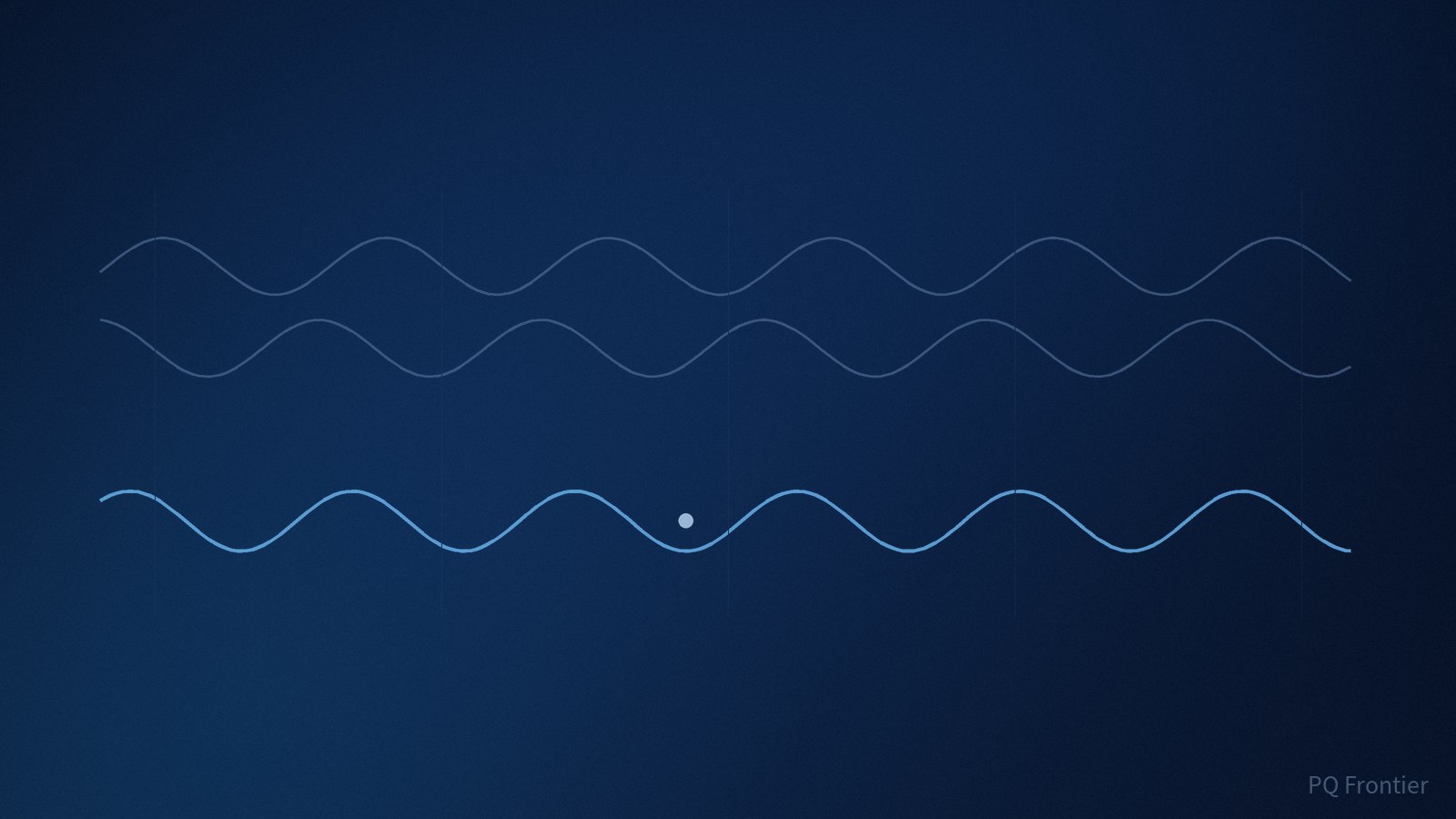
Beginners most often misunderstand superposition in one of two ways: taking “the particle is in two places at once” as a mere figure of speech, or taking superposition as a polite way of saying “we just do not know which state it is in”. Both readings are wrong. Superposition is the core mathematical structure of quantum mechanics, and the point where it parts ways with classical physics. Get the physical picture of superposition straight, and entanglement, decoherence and quantum algorithms will all fall into place.
Probability amplitudes: a kind of “probability” that can cancel
In the classical world, a coin is either heads or tails; when we do not know the outcome, we describe our ignorance with probabilities, which are always positive and can only add. The basic quantity of the quantum world is not probability but the probability amplitude: a complex number. A system in the state yields 0 with probability and 1 with probability .
The crucial difference is that amplitudes carry signs and phases, and when two amplitudes add they can cancel. If the amplitudes of two paths happen to be exactly out of phase, the total amplitude is zero and the corresponding event never happens — even though each path, looked at alone, was “possible”. Nothing like this exists in classical probability: two events that can each happen can only become more likely when combined. This “cancellation of amplitudes” is interference, and it is the decisive evidence that superposition differs from classical ignorance.
A single particle interferes with itself
The double-slit experiment is the most famous demonstration: electrons are fired one at a time, the impact points at first look random, but as they accumulate an interference pattern emerges, as if each electron passed through both slits and interfered with itself. Place a detector behind the slits to see which slit the electron really took, and the fringes vanish at once; the impacts revert to two classical bright blobs.
This experiment rules out the reading “the electron really took one definite slit, we just did not know which”. If the electron really travelled one definite path, whether the other slit is open or closed should not affect the distribution of impacts; but in fact, merely making the other path “available in principle” changes the distribution. The Mach–Zehnder interferometer turns the same logic into a tabletop single-photon experiment: by tuning the phase in one arm, one can make the photon exit deterministically from a chosen port — vary the phase continuously and the exit probabilities oscillate sinusoidally. The only possible conclusion is that before a measurement occurs, the question “which path did it take” has no answer: superposition is a property of the state itself, not of the observer’s knowledge.
Phase: a degree of freedom the classical world does not have
The superposition coefficients and are complex numbers; beyond their magnitudes (which fix the probabilities) each carries a phase. A global phase has no observable effect, but the relative phase between the two components genuinely determines the interference pattern: in phase they reinforce, out of phase they cancel.
This means a quantum state carries far more information than a probability distribution. The probability distribution of a classical bit has a single degree of freedom (the probability of heads), while the superposition state of a qubit lives on an entire sphere (the Bloch sphere), with relative phase as a whole dimension of it. Quantum computation exploits exactly this: most of what quantum gates do is not to change probabilities but to rotate phases precisely, so that computational paths leading to wrong answers cancel each other and paths leading to the right answer reinforce. One could say classical probability theory is “a world of magnitudes only”, while quantum mechanics admits “directions” into the arithmetic of probability as well.
Delayed choice and the quantum eraser: information decides the pattern
Interference has a further, more thought-provoking property. In 1982 Scully and Drühl proposed the “quantum eraser” thought experiment: if which-path information is first recorded by an auxiliary system, the interference fringes disappear; but if that record is afterwards “erased” — making the two paths indistinguishable again — the fringes can reappear in the sorted data. In 1999 Kim and collaborators carried out a delayed-choice version: the decision whether to erase could be made after the photon had already passed the slits. The results agreed with quantum mechanics, but they do not mean the past was rewritten: the fringes appear only in subsamples sorted by the erasure outcome, while the unsorted total distribution never shows fringes. What is rewritten is not history but our understanding of the condition “is the information distinguishable”: the survival of interference depends on whether which-path information is available in principle, not on whether anyone actually looks.
The scale of superposition: from electrons to large molecules
Superposition and interference are not confined to microscopic particles either. In 1927 the Davisson–Germer electron diffraction experiment first confirmed the wave nature of electrons; neutrons and atoms were later made into interferometers as well. The Vienna group of Markus Arndt has for decades pushed the size record of molecular interference: in 2019 they produced interference fringes with large molecules of more than two thousand atomic mass units. These experiments show no sign of superposition failing, and at the same time turn “up to what scale does the superposition principle hold” into a measurable experimental question — precisely where modified theories such as spontaneous collapse part ways with standard quantum mechanics. How far superposition can go remains an open empirical question.
Why this matters for quantum information
Put the three points together: superposition provides an exponentially large state space, interference provides a means of “subtracting” within that state space, and phase provides a programmable control knob. This is the entire physical basis of quantum algorithms and quantum simulation. At the same time, the fragility of interference previews the subject of the next article: as soon as the environment steals even a little which-path information, the phase relations are diluted and the fringes fade. All the engineering effort of quantum information processing is, at bottom, a negotiation with this fragility — and understanding it starts with understanding superposition and interference.
Tags: quantum superpositioninterferenceprobability amplitude