
← Back to section · Quantum Computing
Global Phase and Relative Phase: One Invisible, the Other Carries Information
Why the global phase corresponds to no physical difference at all, how the relative phase is read out by interference and basis changes, and how controlled gates 'kick back' a target's phase onto the control qubit — the shared mechanism behind phase estimation and Shor's algorithm.
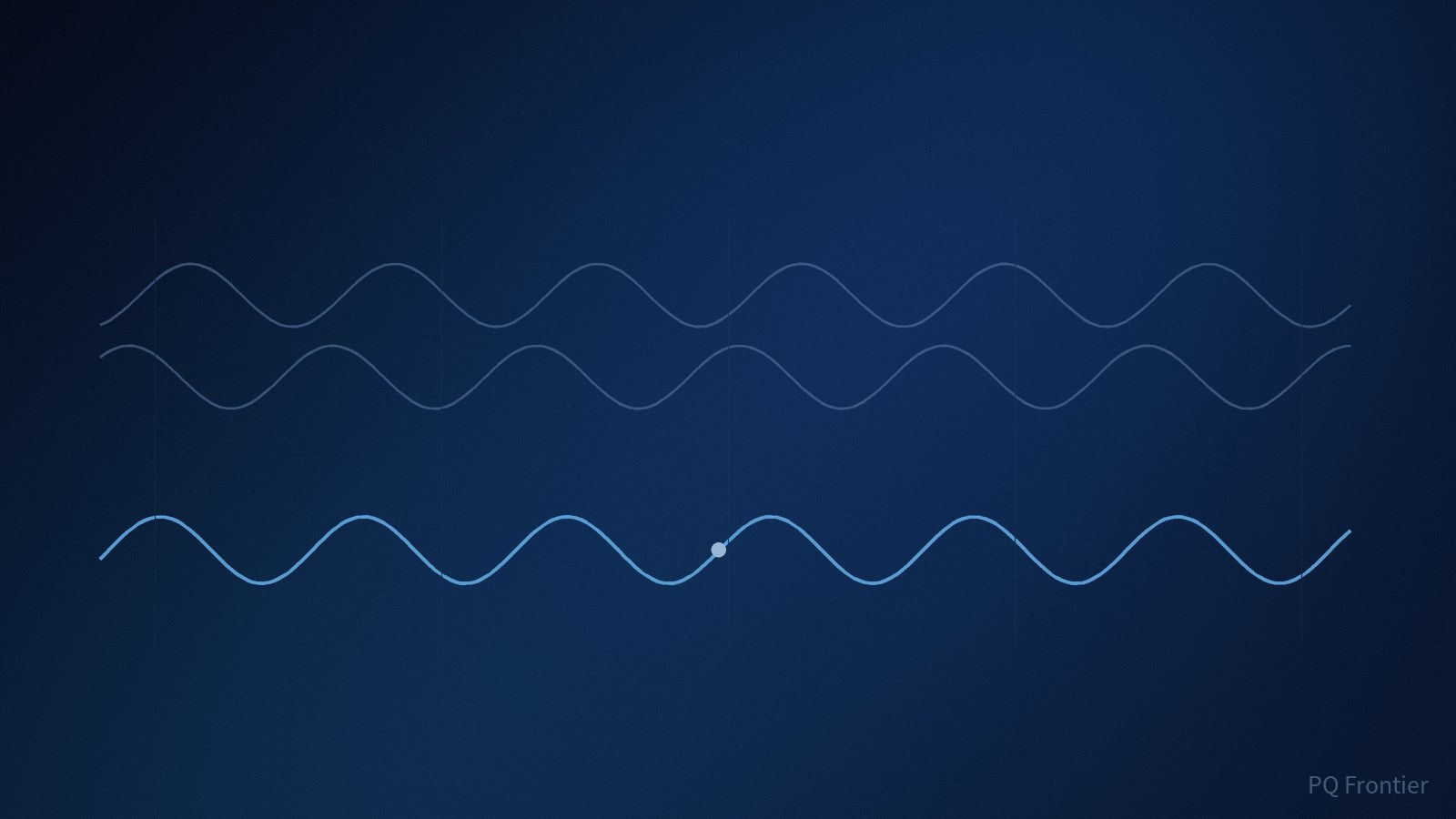
Global Phase: In the Formulas, Not in the World
The coefficients of a quantum state are complex numbers, so every state carries an overall phase freedom: replacing by rotates all amplitudes by the angle simultaneously. Does this transformation change anything? Compute the probability of any measurement outcome: outcome has probability , and multiplying by leaves the modulus unchanged; in expectation values the phase cancels against its conjugate. The conclusion is strict: no experiment — present or future — can distinguish from . They are not “hard to distinguish”; they are two notations for the same physical state.
This fact has practical consequences. When describing a state we may freely fix a convention, such as making the first nonzero amplitude real and positive — the Bloch parametrization does exactly this. Numerical simulations may likewise re-normalize the phase at any time without physical effect. It also reminds us that the state vector is a redundant bookkeeping device: the true physical object is the ray (the complex line spanned by the state vector), and the density matrix eliminates the redundancy automatically — in the outer product the phase cancels as well.
Relative Phase: Information Hidden Inside the Superposition
In contrast to the global phase, the relative phase — the phase difference between components of a superposition — is genuine physical information. Compare with : they differ only by a minus sign on the component, i.e. a relative phase of . Measured in the computational basis, both give 0 and 1 fifty-fifty, indistinguishable; but apply a Hadamard gate first and then measure, and always yields 0 while always yields 1. The basis change has “translated” the relative phase into an amplitude difference.
This is precisely the language of interference: when amplitudes from two paths add, the relative phase decides whether they reinforce or cancel. Much of the power of quantum algorithms comes from manipulating phases — first stamping the “wrong answer” components with a negative phase (relative phase ), then using interference to move amplitude away from the wrong answers. Grover’s amplitude amplification and the phase gradients of the quantum Fourier transform are variations on this technique. One might say: the moduli of the amplitudes decide “what you measure,” the relative phases decide “what it interferes into,” and the speedup of quantum computing lives in the controllability of the latter. Note also that relative phase is meaningful only while coherence lasts: once the environment “peeks” at the system (decoherence), relative phases are randomized and the superposition degrades into a classical mixture — phase information is the most fragile part of quantumness.
The Interferometer: Where Relative Phase Shows Itself
The role of relative phase is clearest inside a concrete device. Consider a Mach–Zehnder interferometer for a photon: after the first beam splitter the photon enters a superposition of two paths; a phase plate on one path adds a phase to that path’s amplitude; the two paths recombine at a second beam splitter and are received by two detectors. The quantum-mechanical calculation: the amplitude at each detector is the sum (or difference) of the two path amplitudes, and squaring gives probabilities varying as and with . Adjust the phase plate and the counts sweep smoothly from “all to detector one” to “all to detector two.” No story of “which path the photon really took” reproduces this result: as long as the path information is in principle indistinguishable, what decides the counts is the relative phase of the two amplitudes; place a detector on one path to peek (even without reading the result — the information merely needs to be available in principle) and the interference fringes vanish, the counts returning to fifty-fifty.
Replace the beam splitters by Hadamard gates and the paths by computational-basis components, and this is the whole content of single-qubit interference: a Hadamard creates the superposition, a phase gate writes the relative phase, a second Hadamard makes the components interfere, and measurement reads out the result. Almost every quantum algorithm decomposes into this three-act structure — prepare a superposition, mark phases, read out by interference — differing only in scale and in how the marking is done. The relative phase is a “carrier of information” precisely because in this three-act structure it plays both roles: the data written in, and the signal read out.
Phase Kickback: Moving a Phase Where It Can Be Measured
Relative phases are real, but not always easy to read directly. A key mechanism relocates them: phase kickback. Let have an eigenstate with eigenvalue . Prepare the control qubit in and apply a controlled- (apply to the target when the control is 1); the target remains unchanged, but the overall effect is:
The target appears untouched, yet its eigenphase has been written into the relative phase of the control qubit — and a control qubit’s relative phase can be read directly with a Hadamard plus measurement (the outcome probability varies with ). This is no small trick; it is the core step of the quantum phase estimation algorithm: applying controlled- repeatedly lets one read out the binary expansion of the eigenphase bit by bit. Factoring large numbers with Shor’s algorithm and finding ground-state energies in quantum chemistry both rest on this channel of “moving an unmeasurable phase onto a measurable qubit.” The key to understanding kickback is the entanglement viewpoint: during the controlled operation the two qubits are generally briefly entangled, and the phase is transferred through that correlation — one more demonstration that in the quantum world, phase is not decoration but information that can be stored, transported, and read.
One more kind of phase deserves a name: the geometric phase (Berry phase). When a quantum system is slowly and adiabatically carried around a closed loop and returns to its starting point, besides the dynamical phase fixed by energy and time, the state picks up an extra phase that depends only on the geometry of the loop. It too is a real effect in the relative-phase sense, measurable in interference, and because it depends only on the shape of the path and is insensitive to certain noises, it has been studied as a route to robust quantum gates. That is as far as we take it here: the reader need only remember that the family of phases has, besides the “globally invisible” global phase and the “between components” relative phase, this member determined by the geometry of the evolution path.
Tags: quantum phaseinterferencephase kickback