
← Back to section · Quantum Computing
Quantum Error Correction: Surface Codes, Thresholds and Logical Qubits
Why a quantum computer needs thousands of physical qubits to protect one logical qubit — error models, the surface code, the threshold theorem, and Willow's below-threshold demonstration.
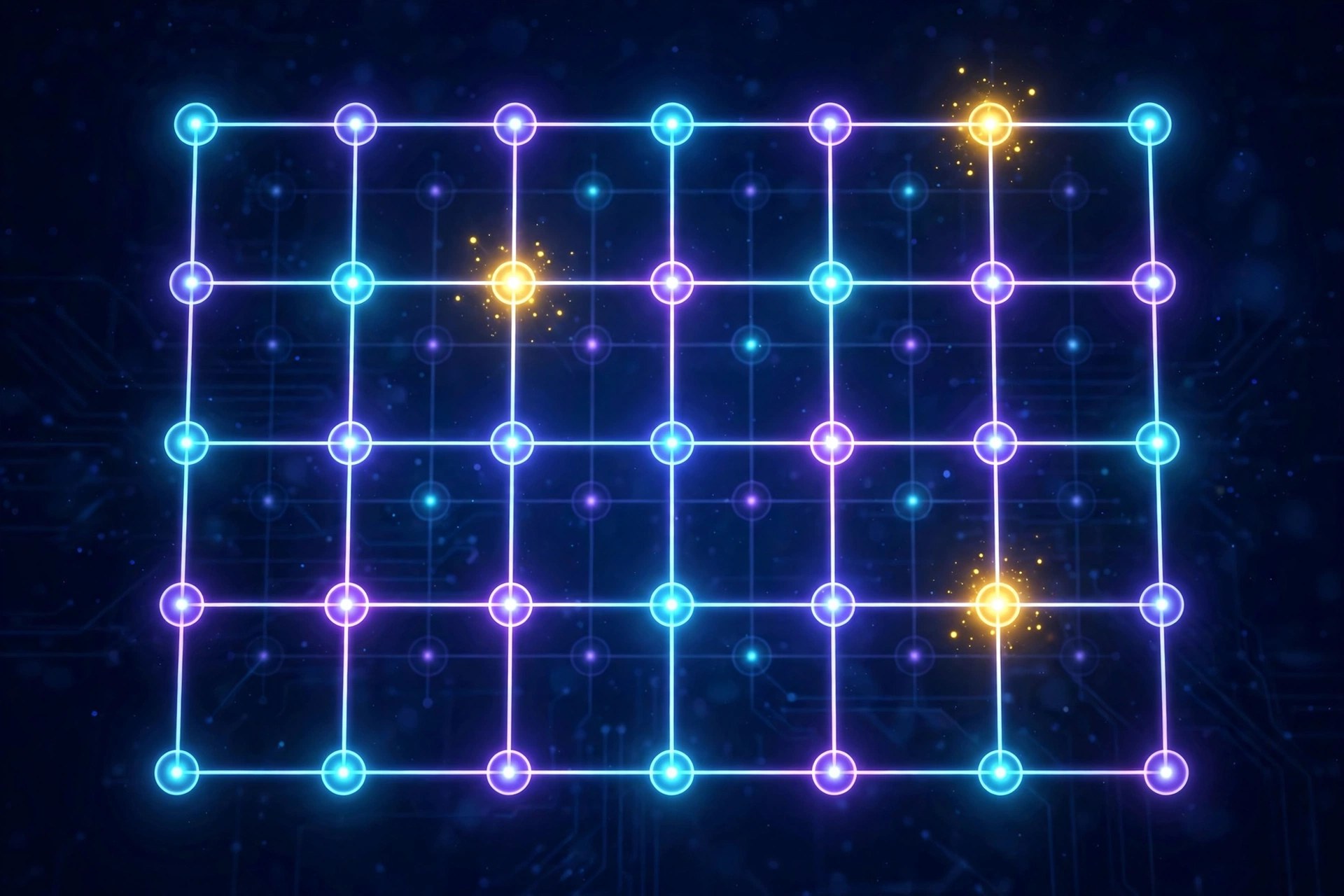
Qubits are notoriously fragile: a whisper of environmental coupling or a slightly-off control pulse quietly corrupts a superposition. Worse, the classical fix — copy the data and take a majority vote — is forbidden by the no-cloning theorem. Quantum error correction (QEC) solves the problem within the rules of quantum mechanics, and its progress is the central variable in every estimate of how far away a cryptographically relevant quantum computer is (see our Shor’s algorithm article for the resource side).
The core idea: make errors measurable
QEC encodes the information of one logical qubit non-locally across the entangled state of many physical qubits. Errors (bit flips X, phase flips Z) change certain observables of that state — the syndrome. By measuring syndromes repeatedly, a classical decoder infers which qubit most likely suffered which error and corrects the bookkeeping in software, never measuring — and never collapsing — the protected data itself.
The price is redundancy, and it is steep. A distance- surface-code logical qubit needs roughly data qubits plus ancillas. To reach logical error rates low enough for Shor’s algorithm (around per operation) at a physical error rate of , must be 25–30 — about 1,000–1,500 physical qubits per logical qubit. Multiply by the thousands of logical qubits the algorithm needs, and you get the famous “tens of millions of physical qubits” figure.
The threshold theorem: why correction can work at all
The threshold theorem is QEC’s foundation: if the physical error rate sits below a threshold (about 1% for the surface code), increasing the code distance suppresses the logical error rate without bound, at only polynomial overhead. Above threshold, correction introduces more errors than it removes, and no amount of hardware helps.
That line defines the industry’s real race: push physical error rates from percent down to per-mille, and prove that logical errors actually shrink as codes grow. In December 2024 Google published the Willow results in Nature: scaling surface codes from distance 3 to 5 to 7 cut the logical error rate by a factor of about 2.14 at each step, and the logical qubit outlived its best physical qubit — the landmark demonstration of below-threshold operation, and the point where error correction turned from principle into engineering.
Why the surface code leads
- Locality — only nearest-neighbour interactions on a 2D grid, a natural match for superconducting chip layouts;
- High threshold — around 1%, the most forgiving of any code family;
- Mature decoding — minimum-weight perfect matching and its successors have two decades of work behind them, and real-time decoding pipelines (FPGA/ASIC) are being engineered now.
Challengers are coming: qLDPC codes (such as IBM’s bivariate bicycle codes) trade long-range coupling for far lower encoding overhead and have advanced quickly since 2024; bosonic codes (cat, GKP) push correction down into a single resonator. The winner is undecided, but the axis of competition for the next five years is clear: not who has the most physical qubits, but who has the cheapest logical qubit.
The error model: how continuous noise becomes a discrete ledger
Physical errors do not arrive neatly labelled X or Z. Real noise is continuous: a rotation that overshoots by a fraction of a degree, a slow phase drift, energy relaxation pulling |1⟩ towards |0⟩ (the T1 process), dephasing that randomises phase relations (T2), and the nastier phenomenon of leakage, where a qubit escapes the computational subspace into a third level. Error correction works because of a key fact: error discretisation. Any small continuous error on one qubit can be expanded as a linear combination of the Pauli operators {I, X, Y, Z}; when a syndrome measurement locates the error, it simultaneously projects that continuous superposition onto one definite Pauli error. Continuous noise is thereby booked as discrete, enumerable error events — a ledger a classical decoder can actually work on.
The ledger is not perfect. Errors correlate: a single high-energy particle event can flip a whole patch of a chip at once (such correlated bursts were observed in the Willow experiments), breaking the independence assumption behind threshold calculations. Leakage, meanwhile, is invisible to ordinary syndromes and needs dedicated leakage-reduction operations to sweep it away. How honestly an error model is written decides whether a resource estimate can be trusted — which is why the first question to ask of any error-correction demonstration is: under what noise assumptions were those error rates measured?
The decoder: the classical half of error correction
Syndromes are only raw data. Translating thousands of syndrome bits per round into “what most likely went wrong” is the decoder’s job — a purely classical inference problem. The classical surface-code decoder is minimum-weight perfect matching (MWPM): triggered detectors are paired up so as to find the lowest-weight set of error chains on a space-time graph. A newer generation of decoders (neural networks, union-find, belief propagation with ordered statistics) trades accuracy against speed differently, but the constraint is shared: it must run in real time. A superconducting platform produces a syndrome round roughly every microsecond; if decoding falls behind, unprocessed data piles up (the backlog problem) and logical operations stall to a halt. Decoders are therefore moving from software into hardware — FPGA and ASIC decoder chips, and even proposals to put decoding logic into the cryogenic electronics. Half the error-correction race is run on quantum chips; the other half is run on classical ones, a fact that qubit-count headlines routinely miss.
What it means for security planning
For cryptography, QEC’s pace sets the harvest-now-decrypt-later window: every step down in physical error rates and logical-qubit overhead shrinks the machine needed to break RSA-2048. When you follow this field, ignore qubit-count headlines and watch three numbers instead: the physical error rate, the logical error suppression factor per distance step (Λ), and the count of demonstrated logical qubits. Those are the coordinates a migration timeline should be anchored to.
Sources and further reading
- Google Quantum AI, Quantum error correction below the surface code threshold, Nature 638 (2025). https://doi.org/10.1038/s41586-024-08449-y
- Fowler et al., Surface codes: Towards practical large-scale quantum computation, Phys. Rev. A 86, 032324 (2012).
- Bravyi et al., High-threshold and low-overhead fault-tolerant quantum memory, Nature 627 (2024).
Tags: quantum error correctionsurface codefault tolerance