
← Back to section · Quantum Computing
Superposition and Interference: The Actual Working Mechanism of Quantum Algorithms
Superposition alone produces no computational advantage; interference does. Amplitudes carry phases, so paths can reinforce or cancel; a quantum algorithm is essentially a choreographed interference pattern that moves probability from wrong answers onto the right one. This article explains how superposition, phase, and interference fit together, and why interference is so fragile.
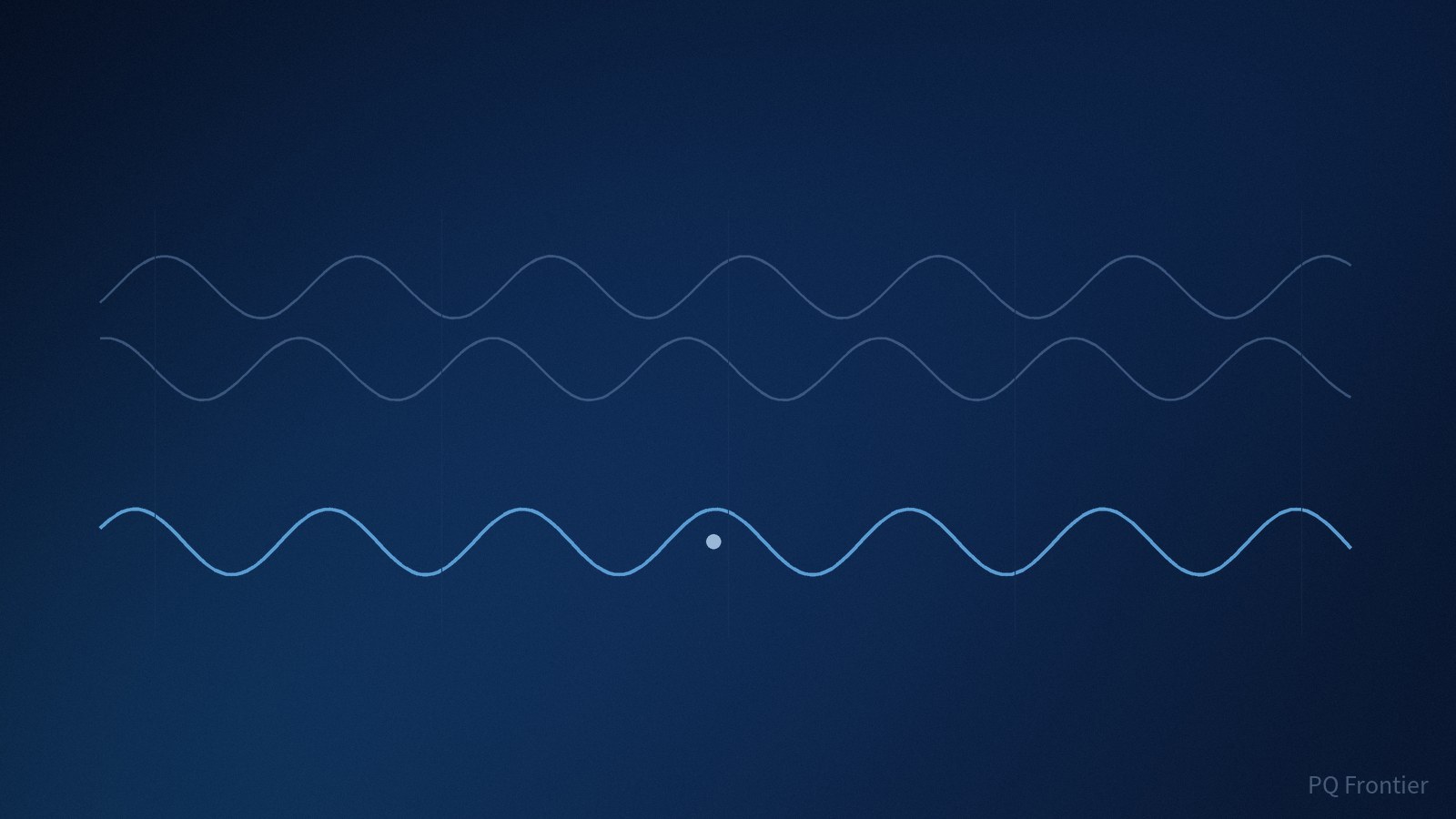
Popular accounts like to credit the power of quantum computing to “superposition: a qubit can be 0 and 1 at the same time.” That explanation is incomplete and even misleading: a classical probabilistic mixture can also be “uncertainly 0 or 1,” and waves in a glass of water superpose too. The real engine of quantum computing is the next step after superposition — interference. Without interference, a superposition is a fog from which no result can be read; with interference, the probability inside the fog can be redistributed and concentrated onto the correct answer.
Superposition: adding amplitudes, not mixing probabilities
First, separate the concepts. A classical probabilistic mixture says: “this bit is 0 with probability 50% and 1 with probability 50%; I just don’t know which.” Quantum superposition says something else: the state α|0⟩+β|1⟩ is a definite, complete physical state, where α and β are probability amplitudes — quantities that can be negative or complex, with observation probabilities given by their squared magnitudes. The experimental difference shows immediately: apply certain operations to a mixture and then measure, and the results are indistinguishable from “it was fixed all along, I just didn’t know.” Apply the same operations to a superposition (a second Hadamard gate, say), and |0⟩+|1⟩ versus |0⟩−|1⟩ — two superpositions indistinguishable by a 0/1 measurement — evolve into completely different measurement outcomes. The difference hides in the phase, a dimension that simply does not exist in the classical probabilistic world.
The same holds for many qubits: a superposition of n qubits is a whole consisting of 2^n basis states, each carrying an amplitude. The significance of superposition is that a computation can “act on all components at once”: one quantum gate applied to a superposition transforms the amplitude of every component. But note that this only sets the stage — all components are still present, and a measurement can only sample one of them at random. Concentrating the probability is the job of interference.
Interference: add the amplitudes first, square afterwards
The mathematics of interference fits in one sentence: when two paths lead to the same measurement outcome, their amplitudes are added first, and the probability is the squared magnitude of the sum. If the two amplitudes are a and b, the combined probability is |a+b|² = |a|²+|b|²+2Re(a*b) — the extra cross term is the interference term, and it can be positive or negative: equal phases give a probability larger than the sum of the individual probabilities (constructive interference), opposite phases can cancel it to zero (destructive interference). Compare classical probability theory: the probabilities of two mutually exclusive paths are computed separately and added directly; contributions are always positive, and cancellation is impossible. Whether the probability of wrong answers can be “subtracted away” is the watershed between quantum and classical probabilistic computation.
Physically this is the same phenomenon as the double-slit experiment in optics: photons passing through two slits land on the screen in a pattern where some positions are always bright (constructive) and some always dark (destructive), and even firing one photon at a time accumulates the same pattern — each photon interferes with itself. A quantum algorithm is a multi-dimensional double-slit instrument: each “path” of the computation is a basis-state component, the gates adjust the relative phases of the paths, and the final interference pattern determines the distribution of measurement outcomes.
In real experiments interference is rarely perfect: the constructive spots are not infinitely bright and the destructive spots are not fully black; the contrast between them is called the interference visibility. Visibility directly measures the “quantum quality” of a superposition — decoherence and phase noise show up first as a drop in visibility, and only then as a wholesale classicalization of the outcome distribution. When experimentalists calibrate a quantum device, what they very often measure is precisely the visibility of various interference patterns; its fall from 1 to 0 is the entire process by which a quantum computation degenerates into a classical probabilistic one.
How algorithms use interference
Every known quantum speedup is, at heart, a carefully designed interference scheme. An intuitive example is Deutsch’s problem (deciding a global property of a one-bit function): the algorithm first prepares a superposition, lets the function write the answer information into the phase of one component (phase kickback), then uses a Hadamard gate to convert the phase difference into interference — the correct branch interferes constructively, the wrong branch destructively, and a single measurement reads out the answer. The core operation of Grover’s search is called amplitude amplification: a pair of reflections applied repeatedly makes the target component’s amplitude grow round by round, like a swing being pushed in rhythm, while the irrelevant components shrink correspondingly. Shor’s algorithm uses the quantum Fourier transform to encode periodic structure into interference peaks: only measurement outcomes aligned with the period appear constructively, the rest are suppressed by cancellation. The forms differ; the core is the same: encode information into phase first, then use interference to translate phase into probability.
This also explains why quantum algorithms are so rare and hard to design: the interference pattern must be tailored to the specific mathematical structure of the problem, and there is no universal procedure that takes a classical program and automatically speeds it up.
The fragility of interference: decoherence
Interference works only as long as the phase relations between paths remain definite. And phase relations are easily destroyed: if any component couples even very weakly to the environment — a stray photon, a lattice vibration, noise in a control signal — the environment effectively “peeks” at which path the system took; once which-path information leaks, the interference term vanishes with it and the superposition degrades into an ordinary classical probabilistic mixture. This process is called decoherence, and its timescale (the coherence time) directly determines how fast quantum gates must be and how strong error correction has to be. Most of the effort in quantum computing engineering — dilution refrigeration, shielding, material purification, quantum error correction — is ultimately a fight with decoherence over how long the interference pattern survives.
Summary
Superposition spreads the possibilities out; interference gathers the probability back in. Keep this division of labor in mind: when discussing quantum advantage, first ask “what is the interference pattern?”; when discussing quantum hardware, first ask “how long does coherence last?” The next article takes up entanglement — the most special and irreplaceable kind of structure within multi-qubit superposition.
Tags: superpositioninterferenceprobability amplitudephase