

Qubit
Representation, control and decoherence of qubits.
A subcategory of Quantum Computing, collecting its introduction, articles and resource entry points.
Articles here

The Geometry of the Bloch Sphere: How Two Angles Hold Every Single-Qubit State
Writing a single-qubit state as cos(θ/2)|0⟩ + e^{iφ}sin(θ/2)|1⟩: where the half-angle comes from, why antipodal points are orthogonal states, why unitary evolution is a rotation of the sphere, and the geometry of measurement probabilities along an arbitrary axis.
Bloch spherequantum stategeometric representation

The Two Clocks of Decoherence: T1, T2, and the Echo
Separating energy relaxation (T1) from dephasing (T2): how the Bloch vector shrinks in each case, why T2 ≤ 2T1, why T2* and the spin-echo T2 differ, and how decoherence turns a superposition into a classical mixture.
decoherenceT1T2spin echo

The Density Matrix: When a Quantum State Can Only Be Described Probabilistically
Introducing the density matrix ρ from the outer product of a pure state: the ensemble meaning of mixed states, the Tr(ρ²) criterion, the relation between Bloch-vector length and purity, and why the partial trace makes entangled subsystems necessarily mixed.
density matrixmixed statespartial trace

Measurement and the Born Rule: How Quantum Information Becomes a Classical Answer
From the Born rule and projective measurement: how the choice of measurement basis decides what can be read out, collapse and repeatability, why POVM generalized measurements are needed, and the statistical reality that expectation values are estimated by repeated sampling.
quantum measurementBorn rulePOVM

Many Qubits and the Tensor Product: Where 2ⁿ Dimensions Come From, and When Entanglement Appears
Building multi-qubit Hilbert spaces with the tensor product, the factorizability criterion a₀₀a₁₁ = a₀₁a₁₀ for product states, a proof that Bell states cannot be factorized, and how the Schmidt decomposition reveals entanglement at a glance.
tensor productentanglementmulti-qubit systems
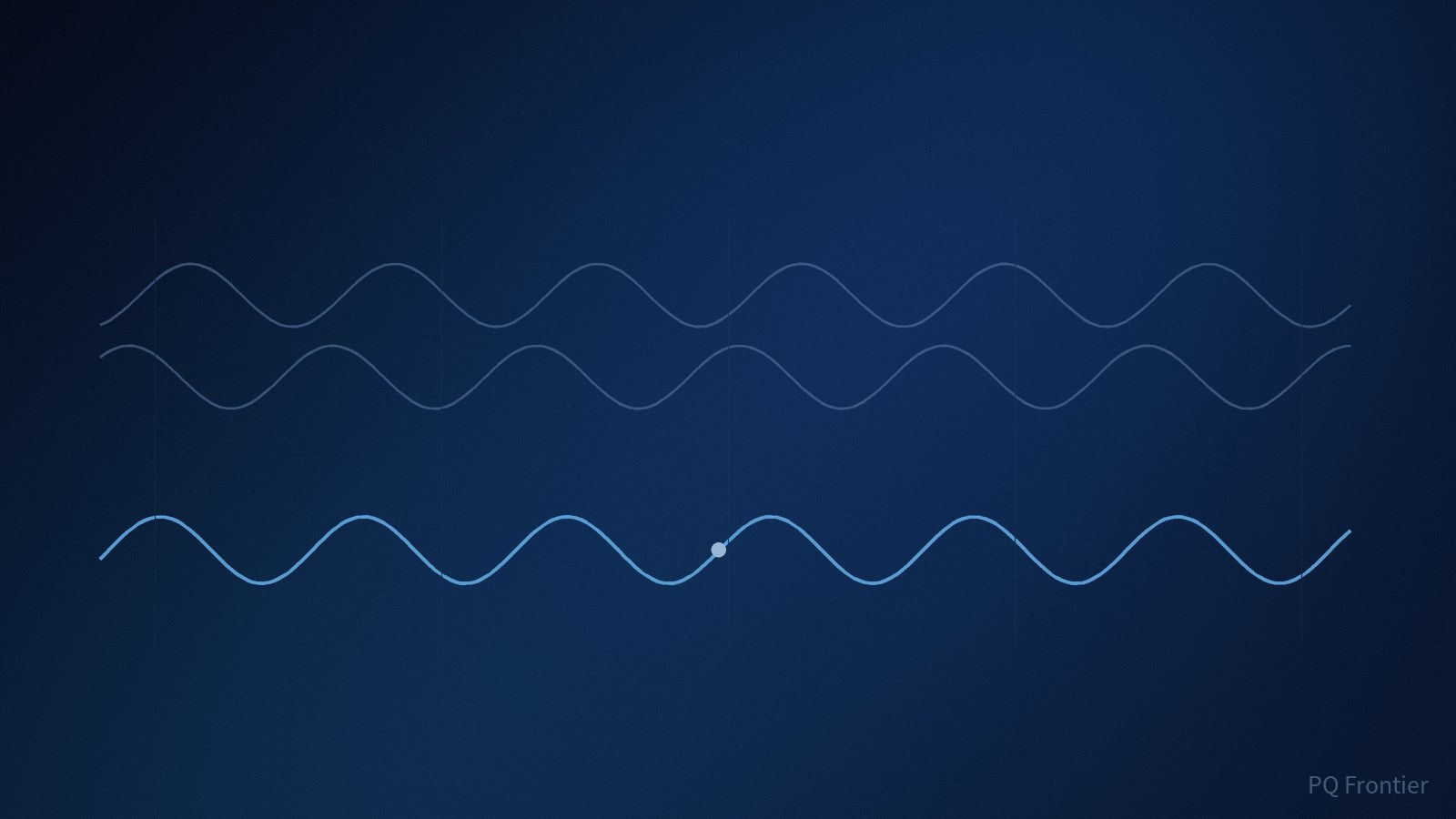
Global Phase and Relative Phase: One Invisible, the Other Carries Information
Why the global phase corresponds to no physical difference at all, how the relative phase is read out by interference and basis changes, and how controlled gates 'kick back' a target's phase onto the control qubit — the shared mechanism behind phase estimation and Shor's algorithm.
quantum phaseinterferencephase kickback
What Qualifies as a Qubit: The DiVincenzo Criteria and the Trade-offs of Physical Carriers
Using DiVincenzo's five criteria (plus two more for communication) to define a 'qualified' physical qubit, analyzing the intrinsic tension between isolation and control, and comparing the mainstream carriers across coherence, gate speed, connectivity and more.
physical qubitsDiVincenzo criteriaquantum hardware

Quantum State Tomography: How to 'Measure Out' an Unknown Quantum State
The basic protocol of tomography: repeatedly measuring in several bases, reconstructing the Bloch vector or density matrix from expectation values, maximum-likelihood enforcement of physicality — and the exponential cost of 4ⁿ parameters, with modern alternatives such as classical shadows.
quantum state tomographydensity matrixfidelity