
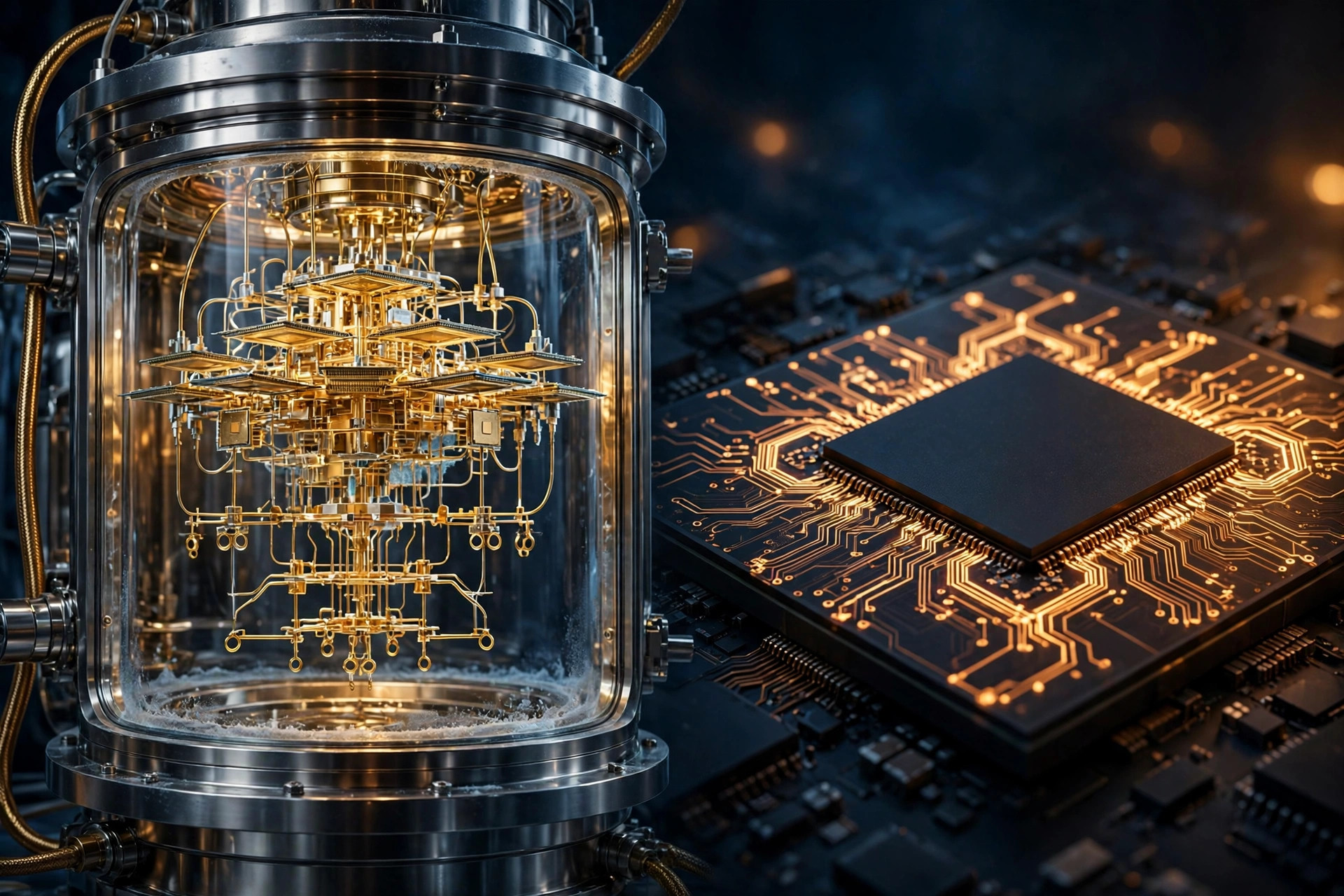
Quantum Chips
Design and fabrication of quantum chips.
A subcategory of Hardware & Chips, collecting its introduction, articles and resource entry points.
Articles here
Fabrication Consistency and Yield: Why Frequency Spread Is the Quantum Chip's Number-One Enemy
Quantum chip yield is not simply the fraction of working chips: every qubit's frequency, coherence time, and coupling strength must land inside its window. This article dissects the sources of frequency spread, the frequency-collision problem, post-fabrication trimming such as laser annealing, and how yield statistics feed back into process improvement.
yieldfrequency spreadprocess consistencylaser annealing
Fabricating Josephson Junctions: How One Layer of Aluminum Oxide Sets a Qubit's Frequency
The heart of a superconducting qubit is a nanoscale aluminum/aluminum-oxide/aluminum sandwich. This article takes apart shadow evaporation and double-angle deposition, oxide formation and aging, resistance-based screening, and why junction-area spread is the first gate of chip yield.
Josephson junctionshadow evaporationsuperconducting qubitsfabrication
Multi-Chip Modules and Flip-Chip Bonding: Assembling Quantum Processors from Pieces
When one die can no longer hold all the qubits and routing, architectures move to multi-chip modules: compute chips, routing chips, and carriers joined by indium-bump flip-chip interconnect. This article covers the cryogenic process essentials of flip-chip bonding, the signal-integrity challenges of multi-chip modules, and what modularity means for quantum error-correction architectures.
multi-chip modulesflip-chipindium bumpsmodularity
On-Chip Wiring and Crosstalk: Every Line Is a Potential Noise Channel
On a quantum chip, drive lines, flux lines, readout lines, and qubits share one surface. This article dissects the topological dilemma of on-chip wiring: the physical sources of crosstalk and calibration matrices, air bridges and ground-plane engineering, line filtering and isolation, and how wiring density becomes a hidden ceiling on qubit count.
on-chip wiringcrosstalkair bridgessignal integrity
Quantum Chip Packaging and High-Density Interconnect: From Wire Bonds to Through-Silicon Vias
A quantum chip must ultimately sit in a package that works at millikelvin temperatures and connect to hundreds or thousands of microwave lines. This article covers package materials and mode suppression, wire-bond and flip-chip interconnect, carriers and interposers, through-silicon vias, and how packaging turns from a logistics problem into an architecture problem.
chip packaginginterconnectflip-chipTSV
Quantum Chip Testing and Screening: From Room-Temperature Probe Stations to Full Cryogenic Inspection
Quantum chip testing is a multi-stage pipeline: room-temperature measurements of junction resistance and line continuity, cryogenic per-qubit measurement of frequency, coherence times, and gate fidelities. This article covers what each test level measures, why cryogenic testing is so expensive, and how automated calibration and test throughput become hidden bottlenecks of scaling.
chip testingscreeningcryogenic testingautomated calibration
Silicon Spin Qubits: The Route That Builds Quantum Chips on a Semiconductor Production Line
Silicon spin qubits trap the spin of a single electron in a semiconductor quantum dot — the only quantum computing route that can directly borrow CMOS manufacturing. This article explains how they work, the post-2022 milestones that pushed fidelities past 99%, and the manufacturing challenges of uniformity, wiring and temperature.
Silicon Spin QubitsQuantum DotsSemiconductor Fabrication
Superconducting Chip Layout and Coupling Structures: How Qubits Are Arranged and Connected
From a single transmon's interdigitated capacitor to the coupler arrays of a two-dimensional grid, this article lays out the design logic of superconducting chip layouts: qubit placement topologies, fixed versus tunable coupling, the role of coplanar waveguide resonators, and how layout-level parasitics constrain the architecture in return.
superconducting chipslayout designcouplerstransmon