
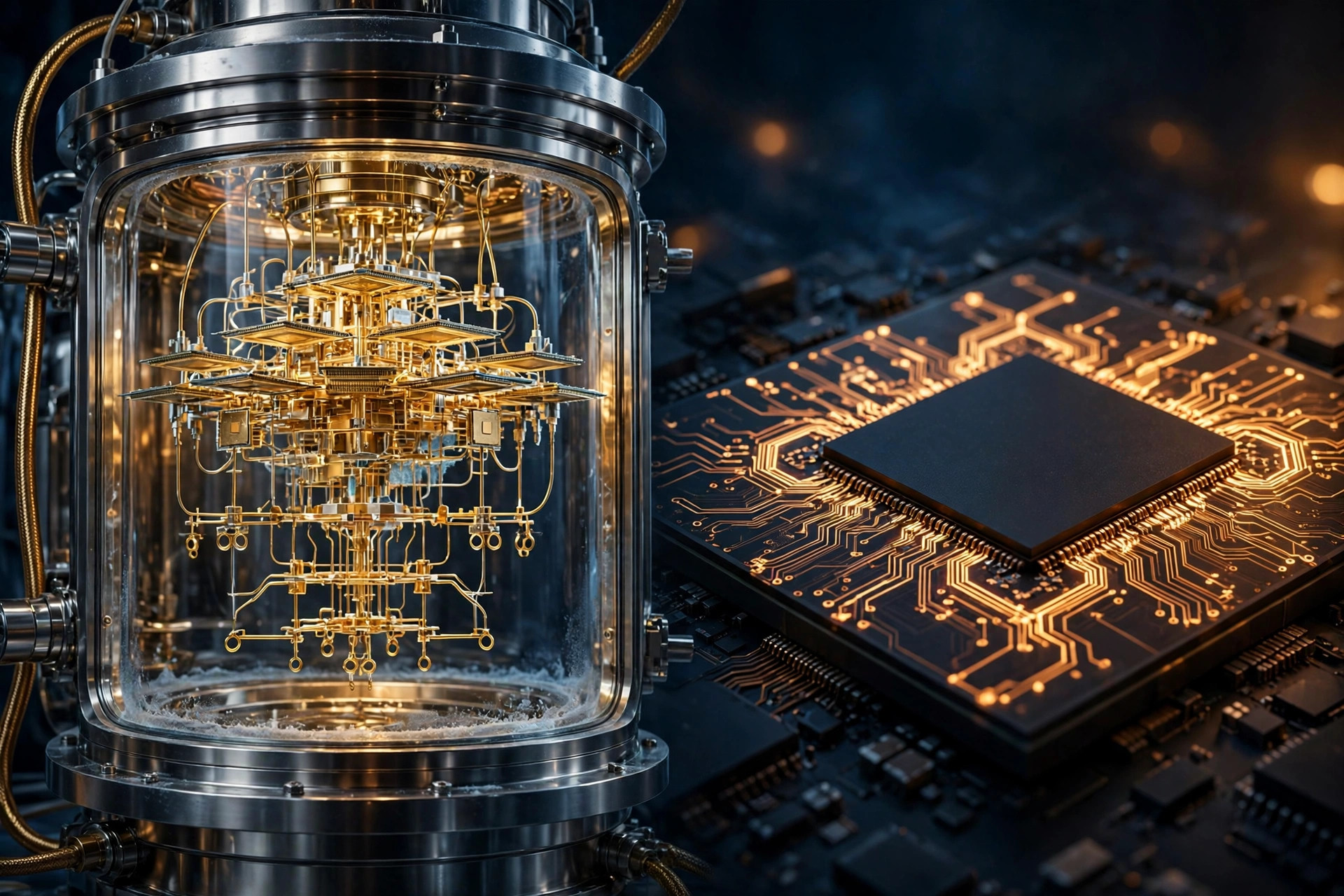
Semiconductor Technology
Where semiconductor technology meets quantum devices.
A subcategory of Hardware & Chips, collecting its introduction, articles and resource entry points.
Articles here

Cleanliness and Defect Control: Quantum Chips Fear Dirt More Than Transistors Do
One dust particle can kill a transistor, but it takes only a few atomic-scale defects to kill a qubit. This article explains how the logic of semiconductor cleanliness control extends to quantum devices: the damage mechanisms and control methods for particles, metal contamination, organic residues and interface states.
cleanliness controldefect engineeringyield

Compound Semiconductors and Photonic Devices: The Fabrication Base of Quantum Light Sources
The photonic quantum route does not run on silicon but on compound semiconductors such as gallium arsenide and indium phosphide. This article explains why compound semiconductors are irreplaceable for emission and photoconversion, the fabrication essentials of quantum-dot single-photon sources and on-chip waveguides, and how they differ from the silicon photonics platform.
compound semiconductorsphotonic devicessingle-photon sources

Cryogenic CMOS Control Chips: Moving the Controller into the Fridge
Qubits live in a millikelvin fridge while their controllers sit at room temperature, joined by thousands of cables. Cryogenic CMOS moves control circuitry to 4 K or below; this article explains the motivation, the thermal-budget ledger, and how transistors change their temperament at low temperature.
cryogenic CMOScontrol electronicsthermal budget

The Semiconductor Supply Chain and Quantum Hardware: On Whose Shoulders Does a Quantum Computer Stand?
However frontier a quantum chip is, it cannot escape wafers, specialty gases, isotope materials and refrigerators. This article maps quantum hardware's dependence on the semiconductor supply chain: which links share mainstream capacity, and which are stuck on niche, fragile supplies.
supply chainsemiconductor industryquantum hardware

SiGe Heterostructures and Isotopically Purified Silicon: A Quiet Home for Electron Spins
Half of a silicon spin qubit's performance is written in its materials. This article explains how Si/SiGe heterostructures use band engineering to confine electrons, why isotopic purification suppresses magnetic noise, and where valley splitting — silicon's peculiar headache — comes from.
SiGe heterostructuresisotopic purificationmaterials engineering

Fabricating Silicon Quantum Dots: From Heterostructure Epitaxy to Multilayer Gates
Silicon quantum dots are not drawn; they are grown, etched and stacked. This article walks through the two mainstream material routes for silicon quantum-dot devices, the gate processes that electrostatically define the dots, and the steps that really limit yield when moving from single devices to arrays.
quantum dotssemiconductor processingsilicon quantum devices

Superconducting Thin-Film Materials: Aluminium, Niobium and Titanium Nitride Each Have Their Own Job
The performance of a superconducting quantum chip hides in its films: aluminium owns the Josephson junction, niobium carries the high-frequency interconnect, and titanium nitride opens another road with high kinetic inductance. This article compares the process personalities and loss sources of the three workhorse superconducting films, and shows how material choice writes itself into qubit coherence.
superconducting thin filmsJosephson junctionsmaterials loss

Why CMOS Compatibility Matters: The Logic of Quantum Chips Borrowing the Semiconductor Industry
「CMOS compatible」 is often used as a slogan for silicon quantum computing, but what exactly is compatible — and what is not — needs spelling out. This article breaks process compatibility into four levels: materials, equipment, design rules and supply chain, and marks where the incompatibilities lie, from cryogenics to quantum-grade cleanliness.
CMOSsemiconductor processingquantum chip fabrication