
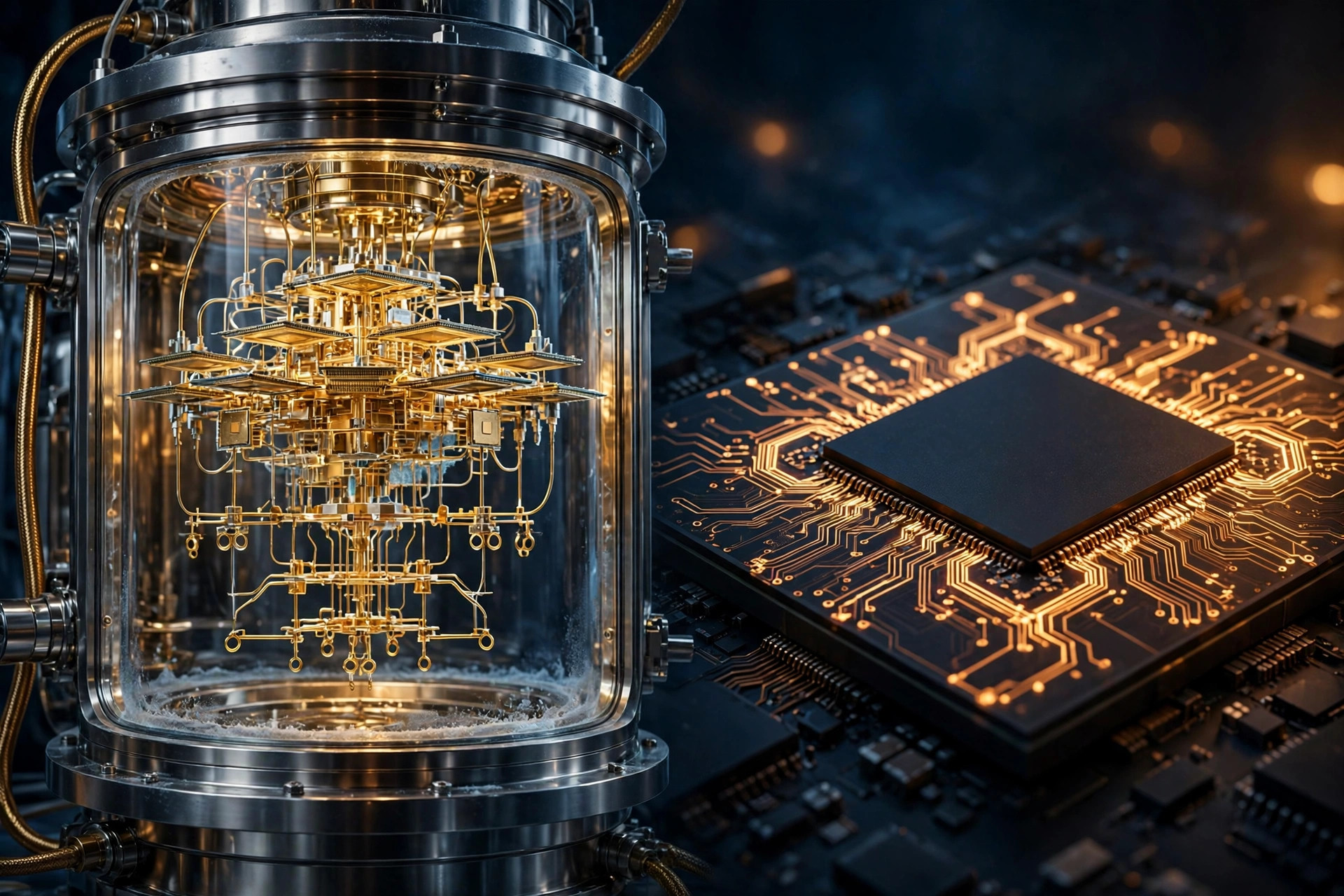
Cryogenics
Dilution refrigeration and cryogenic engineering.
A subcategory of Hardware & Chips, collecting its introduction, articles and resource entry points.
Articles here
The Cryocooler Family Tree: Where GM, Pulse Tube and Dilution Each Belong
No single machine covers the road from room temperature to 10 mK: GM and pulse-tube coolers provide the 4 K platform, JT and sorption stages fill the middle, and the dilution unit runs only the final leg.
CryocoolersPulse TubeGM Cooler
Life at Ten Millikelvin: Dilution Refrigeration for Superconducting Qubits
Superconducting qubits operate hundreds of times colder than deep space. How a dilution refrigerator reaches 10 mK with ³He/⁴He phase separation — and why wiring, not cooling, is the real bottleneck.
Dilution RefrigerationSuperconducting QubitsCryogenics
Anatomy of a Cryostat: The Temperature Layers from Vacuum Vessel to Mixing Chamber
Take a dilution refrigerator apart layer by layer: vacuum vessel, radiation shields, the 50 K and 4 K plates, the Still, the cold plate and the mixing chamber — every layer has a defined temperature, job and mounting rule.
CryostatDilution RefrigerationTemperature Stages
Heat-Load Budgeting: Keeping the Thermal Books of a Cryogenic System
Every cold plate has a cooling-power ceiling; a heat-load budget lists radiation, conduction, cabling and dissipation line by line against that ceiling — the stage that is overspent is the reason the system never reaches its target temperature.
Heat LoadCryogenic EngineeringThermal Design
Operating a Dry System: 'Cryogen-Free' Does Not Mean Maintenance-Free
Dry (cryogen-free) dilution systems abolish the liquid-helium dewar and its transfer losses, but shift the maintenance onto compressors, pumping groups and cold heads — here is the real operations bill and the common failure modes.
Cryogen-FreeDry DilutionOperations
Helium-3: Where the Lifeblood Gas of Dilution Refrigeration Comes From, and How It Is Recovered
Helium-3 is not mined; it is the decay product of tritium. Its scarcity, cost and strategic status are why every laboratory treats recovery and leak prevention as first-order business.
Helium-3Dilution RefrigerationGas Recovery
Vibration, Acoustic Noise and Electromagnetic Shielding: The Invisible Enemies of the Cold Environment
Reaching base temperature is not the same as a qualified environment: compressor vibration, pump acoustics, stray magnetic fields and infrared radiation quietly destroy coherence — vibration control and shielding are the other half of cryogenic engineering.
Vibration IsolationMagnetic ShieldingCryogenic Environment
Wiring and Heat Sinking: Every Cable Is a Two-Way Channel for Heat and Noise
Cables carry control signals into the cold end — and carry heat and room-temperature noise in with them. Heat sinking, attenuation chains and cable-material choices are the art of setting checkpoints along that channel, stage by stage.
WiringHeat SinkingCoaxial Cables