
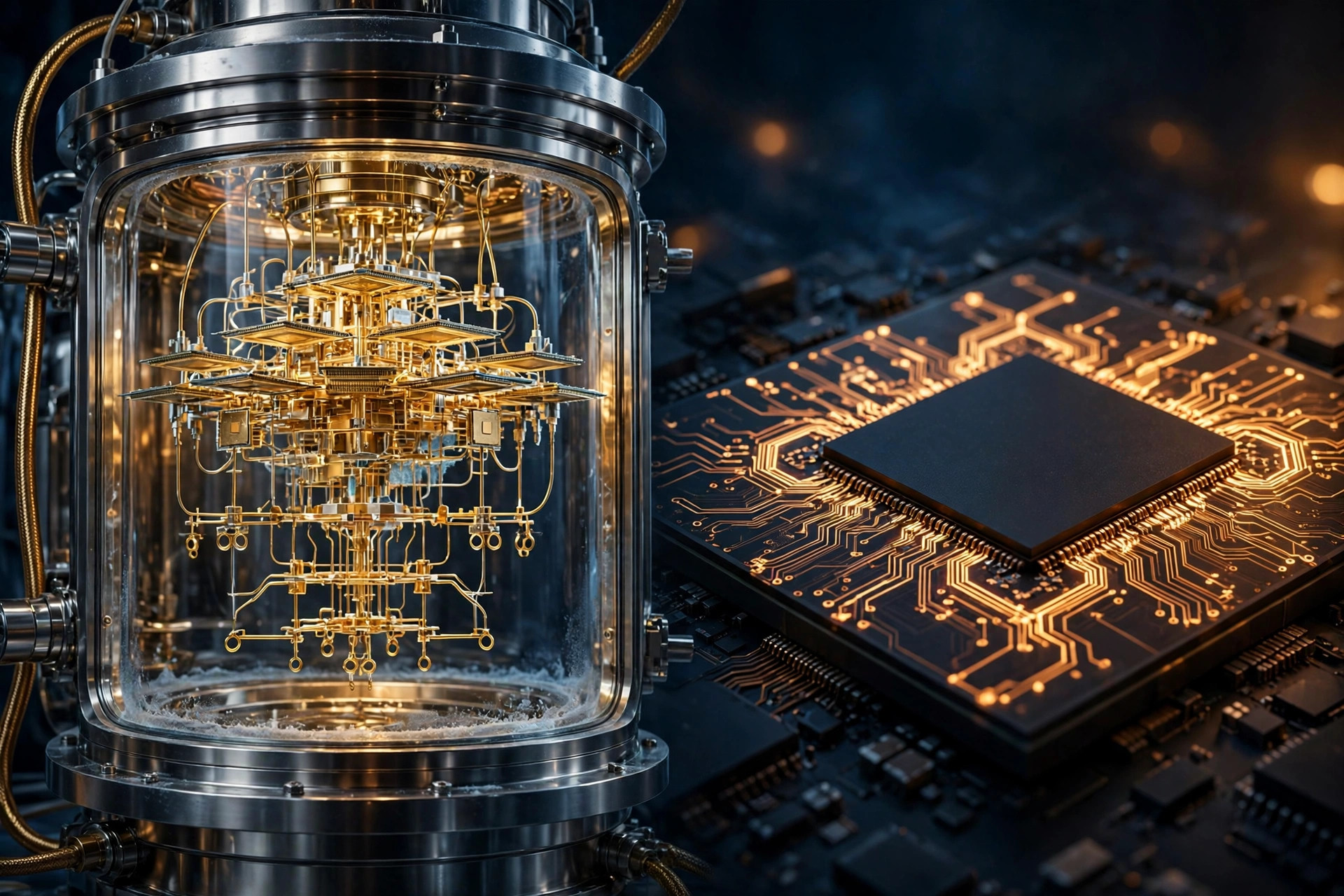
Quantum Processors
Quantum processor progress across technology routes.
A subcategory of Hardware & Chips, collecting its introduction, articles and resource entry points.
Articles here
Anatomy of a Quantum Processor: The Chip Is Only the Tip of the Machine
The golden chandelier and the fingernail-sized chip in press photos are only the innermost layer of a quantum processor. This article dissects a complete quantum computer from the whole-machine perspective: the quantum chip, cryogenic and vacuum systems, control and readout electronics, wiring and interconnects, classical compute and the software stack — and the cost and engineering weight of each.
Quantum ProcessorsSystems EngineeringCryogenicsControl Electronics
The Neutral-Atom Processor as a Whole Machine: Cold Atoms Marshalled in a Tweezer Array
A neutral-atom processor marshals hundreds or thousands of atoms into reconfigurable geometries with optical tweezer arrays. This article surveys its composition from the whole-machine perspective: the vacuum system, laser cooling and tweezer arrays, the Rydberg excitation optics and fluorescence-imaging readout, and how dual analog and digital modes shape the machine's design.
Neutral AtomsQuantum ProcessorsOptical Tweezer ArraysRydberg Atoms
The Photonic Quantum Processor as a Whole Machine: Light Completing a Computer Inside a Chip
A photonic processor has a form factor all its own: the qubits are photons in flight, and the machine is a chain of single-photon sources, a programmable photonic circuit and single-photon detectors. This article surveys the photonic machine's composition, how measurement-based computing shapes its architecture, and why photon loss is the number-one enemy running through every part of the machine.
Photonic Quantum ComputingQuantum ProcessorsIntegrated PhotonicsSingle-Photon Detection
How to Read a Quantum Processor Spec Sheet: A Pitfall Guide from Qubit Counts to Logical Performance
Quantum processor marketing is crowded with metrics: qubit counts, fidelities, coherence times, quantum volume, logical error rates. Every metric has its own measurement convention and scope, and mixing them leads to wrong conclusions. This article takes the mainstream metrics apart one by one — their meanings and their traps — and teaches readers to judge a processor's real quality.
Quantum ProcessorsPerformance MetricsQuantum VolumeBenchmarking

The Semiconductor Spin Processor as a Whole Machine: A Quantum Computer out of the Fab
The whole-machine story of the semiconductor spin route is unlike any other: its core selling point is not any single machine's performance but the entire manufacturing chain. This article surveys the spin processor's composition from the whole-machine perspective: quantum-dot chips, the cryogenic operating environment, the trend toward integrating on-chip control electronics, and how wafer-scale fabrication changes the machine's cost and consistency.
Semiconductor SpinsQuantum ProcessorsQuantum DotsCMOS Processes
The Superconducting Quantum Processor as a Whole Machine: Inside and Beyond the Chandelier
The superconducting route attracts the largest share of industry investment in quantum computing. This article surveys the complete form of a superconducting processor from the whole-machine perspective: the layered structure inside the dilution refrigerator, the microwave control chain, how packaging and wiring swell with qubit count, and the practical constraints — calibration, crosstalk and yield — that decide whether a machine is usable.
Superconducting Quantum ComputingQuantum ProcessorsDilution RefrigerationMicrowave Control

The State of Topological Quantum Computing: A Beautiful Promise Not Yet Delivered
Topological quantum computing promises to encode quantum information in the global topological properties of Majorana zero modes, naturally resistant to local noise. Yet for over two decades its core physical evidence has remained under dispute. This article neutrally surveys the route's physical conception, its key experimental controversies and its current state: what has been established, and what has not.
Topological Quantum ComputingMajorana Zero ModesQuantum ProcessorsResearch Status
The Trapped-Ion Quantum Processor as a Whole Machine: Vacuum Chamber, Lasers and a String of Floating Ions
A trapped-ion processor looks nothing like a superconducting machine: there is no bulky refrigerator — the core is an ultra-high-vacuum chamber, a precision laser-optics system and a trap chip. This article surveys the composition of a trapped-ion machine, how the QCCD zoned architecture reshapes its layout, and the system costs behind all-to-all connectivity and high fidelity.
Trapped IonsQuantum ProcessorsVacuum SystemsLaser Control